

Operational State
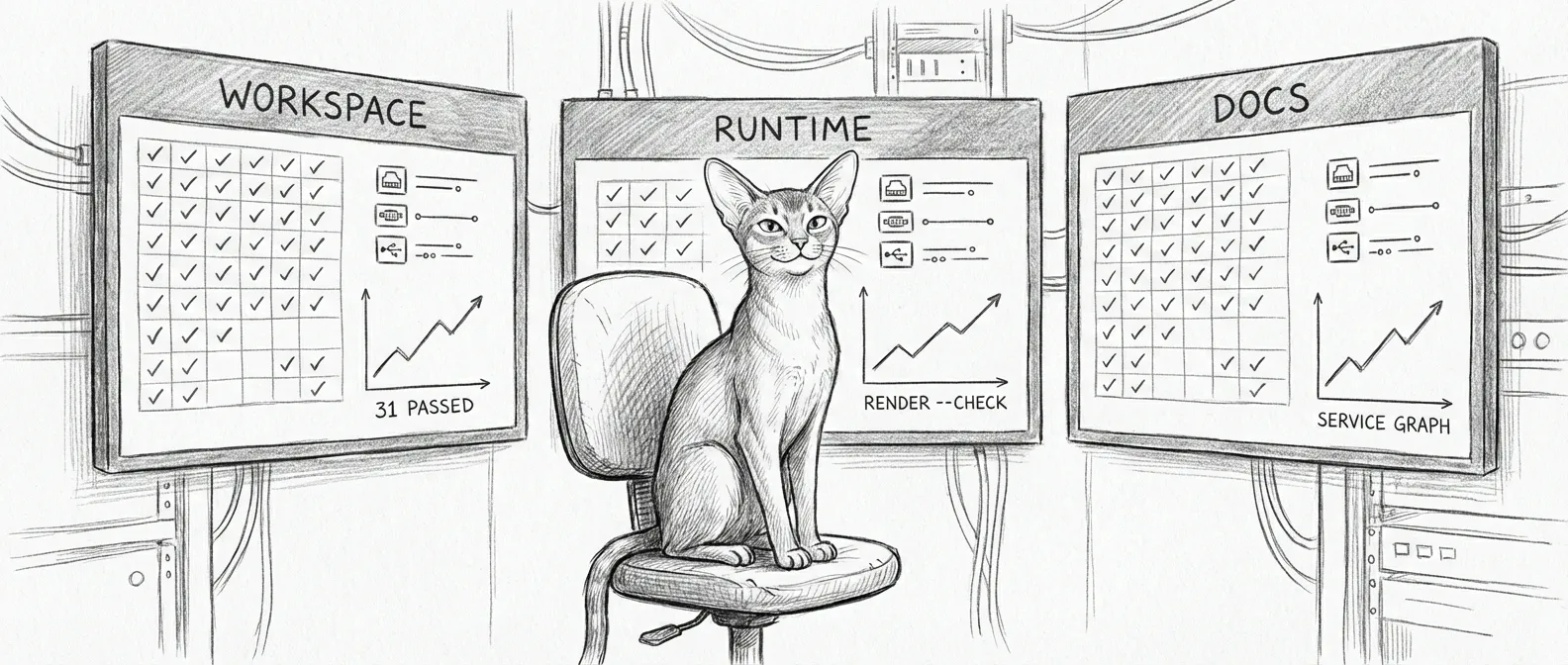
The architecture pages are where Sanctum gets to be beautiful — blueprint, mythology, council sessions in a Québec basement. It is the page that shows up the next morning to check whether any of it actually ran.
Call it the ledger the haus keeps against itself. Less romance, more receipts: what was verified on the actual machine, on an actual Tuesday, by a test run that either passed or didn’t. Tommy watches the dashboards from the corner of the ops center, unimpressed, the way he watched everything in life. Nothing below is a claim. Each line is something that returned exit 0.
The workspace-owned slice
Section titled “The workspace-owned slice”What the workspace repo owns and can prove on its own:
sanctum/catalog.yamlis the checked-in canonical source for the workspace service manifestssanctum/agent_capabilities.yamlis the checked-in canonical source for the Code Forge permission model- The canonical agent persona markdown now lives in the raw
mlx-finetuneworkspaces and is synced mechanically into runtime workspaces via~/.sanctum/scripts/sync_agent_markdown.py sanctum/render_services.py --checkreproduces the checked-in manifests deterministicallytools/sync_runtime_calibration.py --checkverifies that~/.sanctum/.instance.jsonand the template-managed LaunchAgents still match their canonical runtime inputs~/.sanctum/scripts/sync_agent_markdown.py --check --audit-liveverifies that reachable~/.openclaw/workspace*copies still match the canonicalIDENTITY.md,SOUL.md,TOOLS.md, andHEARTBEAT.mdsources and that the MBP still looks like a healthy fanout target~/.sanctum/state/agent-markdown-sync.jsonis now the machine-readable calibration ledger for the most recent local sync or audit passtests/test-sanctum-audit.shcovers rendering, sidecar behavior, graph compatibility, and docs wiringtests/test-agent-markdown-sync-e2e.shproves local sync plus best-effort VM/MBP fanout in a disposable harnesstests/test-sanctum-immune-system.shexercises the live Rust watchdog end to end, including anomaly logging, root-cause remediation, failed escalation, and the local APItests/test-sanctum-code-forge.shexercises the shared Code Forge scripts end to end, including permission rejection, deploy success, rollback, review, list, and audit loggingtests/test-sanctum-evolution-loop.shexercises the real incident-learning, performance-review, and evolution-report scripts together in a disposable Sanctum hometests/test-sanctum-genetic-health.shexercises the localgenome-mcpCLI through its checked-in virtualenv and verifies the exported health profile surfacetests/test-sanctum-tech-lookout.shexercises the tech-lookout scan, brief, and dispatch scripts against a disposable report directory without requiring council-routersanctum/sanctum-spec-surface.yaml,sanctum/kitchenloop-canaries.yaml,sanctum/kitchenloop-tribunal.yaml, andsanctum/kitchenloop.yamlnow define the checked-in Kitchen Loop surfacetools/run_kitchen_loop.pyandtests/test-sanctum-kitchen-loop.shprove the six-phase loop, oracle output, and pause-gate behavior in a disposable state directorynavigator-sidecar.jsexposes aggregate project status and scrubs obvious secret material from its payload
The runtime slice
Section titled “The runtime slice”What the live Mac Mini runtime actually reports:
~/.sanctum/instance.yamlvalidates cleanly~/.sanctum/services/now contains 38 rendered manifests: the watchdog reports38/38 healthyas of 2026-04-18. Includes instance-backed services, SSH tunnel services, and the five off-catalogue services registered during the April 2026 audit (obliteratus,force-flow,sanctum-bridge,livekit-server,reranker)~/.sanctum/config/agent-capabilities.yamlis now present and synced from the checked-in workspace source- Runtime wrappers under
~/.sanctum/binare present com.sanctum.agent-markdown-synckeeps the local runtime markdown aligned at login and every 5 minutes- The installed helper scripts now live under
~/.sanctum/scriptswith absolute paths, which is a less exciting place for launchd to look and therefore a better one - LaunchAgent drift has been remediated to a clean baseline according to the custom auditor, including retirement of the legacy shell-era Living Force plist in favor of the Rust watchdog plist
- The runtime graph now carries explicit verified edges such as
qwen3-tts -> voice-agentinstead of treating every instance service as an isolated root (rename history:xtts→xtts-serverQ2; →qwen3-tts2026-04-25 after the Coqui→Qwen3 backend swap) - The watchdog API snapshot now clears resolved root causes after a successful self-heal instead of reporting stale pre-remediation causes
- The
instance.yamlJSON cache and template-managed LaunchAgents are now part of the checked calibration surface instead of being unverified byproducts - Reachable remote nodes are now part of the markdown calibration path: the VM is synced over the configured SSH alias, and mobile nodes such as the MBP are updated opportunistically when reachable over Tailscale
- The MBP now behaves as a passive fanout target by default. If it is offline, the Mac Mini skips it. If it is online, it receives the canonical markdown and records a healthy
fanout-targetstatus instead of trying to reinvent the council from a stale local checkout
The documentation slice
Section titled “The documentation slice”Where the rest of the story lives:
- Stable architecture doctrine lives primarily in The Living Force
- Dated changes and migration events live in Operational History
- Audit-style corrections live in Implementation Audit, Runtime Drift Audit, and Feature Status Matrix
What This Means Practically
Section titled “What This Means Practically”Sanctum is in better shape than it was when the audit started:
- one canonical checked-in service catalog for the workspace slice
- deterministic manifest generation
- a cleaner sidecar contract
- end-to-end audit coverage on the parts we touched
- a mechanically proven immune-system loop instead of a mostly-plausible one
- a mechanically proven Code Forge pipeline instead of a narrative one
- a mechanically proven evolution loop instead of a missing weekly synthesis step
- a mechanically proven genetic-health layer instead of a purely doctrinal one
- a mechanically proven tech-lookout pipeline instead of a Jocasta-only architecture promise
- a mechanically proven Kitchen Loop surface instead of a pure architecture blueprint
- a mechanically checked runtime calibration surface instead of stale generated artifacts hiding in plain sight
- a mechanically checked persona-calibration surface instead of hand-edited markdown drifting between machines
- a mechanically checked live-node audit for the MBP instead of assuming the road machine probably did the right thing
- runtime LaunchAgent drift repaired
- documentation boundaries made explicit
What Is Still Not True
Section titled “What Is Still Not True”A few claims remain too generous if stated without qualifiers:
- Sanctum is not yet a single-repo system
- Sanctum is not yet a fully portable install experience
- The runtime layer still depends on local state outside the checked-in workspace
Those are not failures. They are the boundaries of the current design — the part of the map where it still says here be dragons, and on a quiet enough night, if you listen, you can hear them snoring.