

2026-06-29: The Form That Could Wipe the House
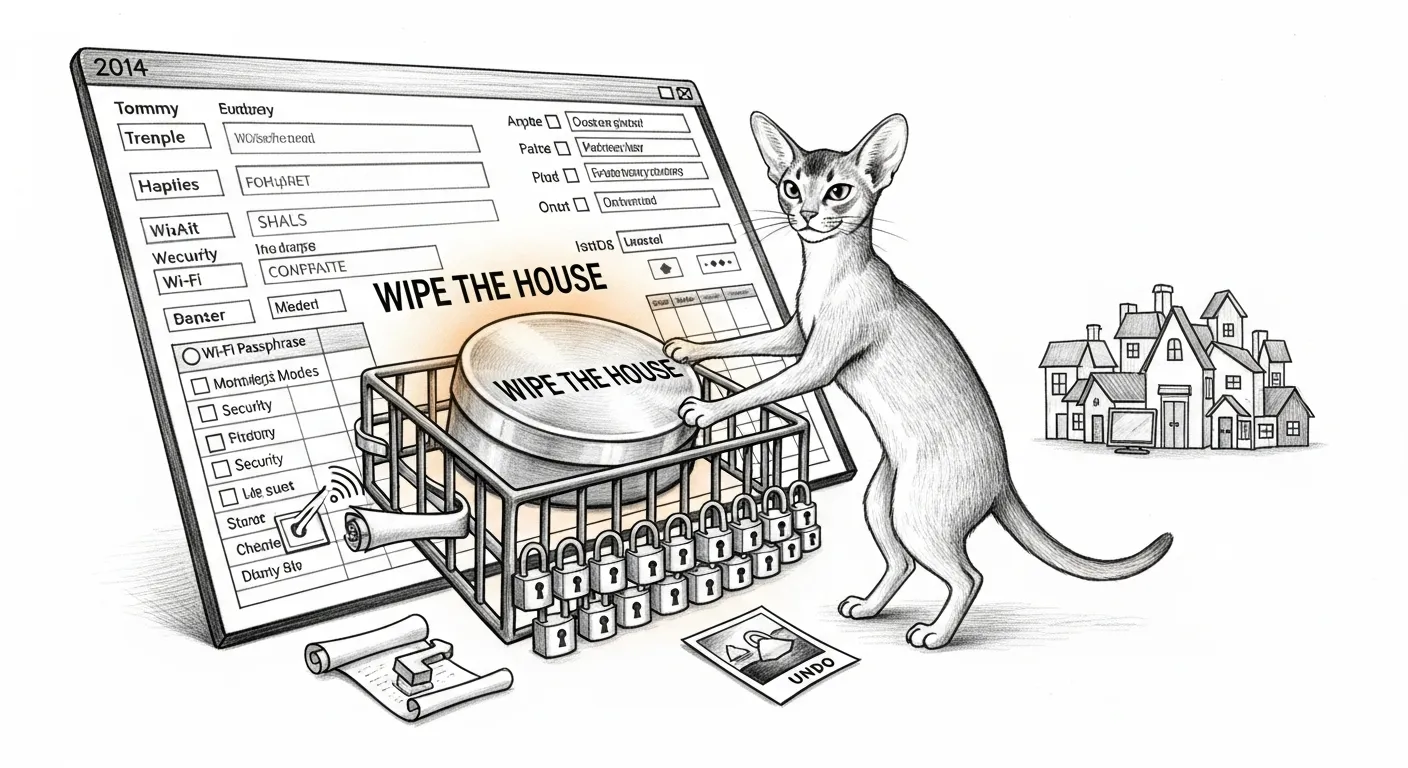
The ask was simple, the way the dangerous ones always are: make the router configure its own Wi-Fi. Rename an SSID, rotate a passphrase, all of it from code, the apple way — guided, verified, invisible. The catch is that the only door into the mesh router’s wireless settings is a single 2014-era CGI form, and that form carries every WPA passphrase in the house in its body. Submit it with one field wrong — a blanked key, a security mode that quietly downgrades — and the whole household Wi-Fi goes open, or every device drops at once. The blast radius is the entire house.
So the rule wrote itself: never POST that form blind.
The make-or-break question
Section titled “The make-or-break question”Before any of the safety scaffolding, one question decided whether a safe write was even possible: when the form submits, is the passphrase sent as you typed it, or is it hashed first? If the page MD5s the key before POSTing, then reading the current value and writing it back would double-process it — and lock the whole house out on the next reconnect.
The form loads md5.js. Promising, ominous. We read it anyway. The one and only
call site for calcMD5() turned out to feed the legacy WEP key generator — dead
code on a device that blocks WEP entirely. Every WPA field is sent raw. A
read-modify-write that copies the current value back through, untouched, is safe.
That single fact is what made the rest buildable.
Twenty-one locks
Section titled “Twenty-one locks”The write path never just writes. It:
- Snapshots the full current form — every field, all seven passphrases — to
a
0600file, and refuses to trust that snapshot as a rollback source if any key reads blank or masked. - Dry-runs by default: it computes the exact old→new diff (passphrases shown
only as length + hash, never plaintext) and POSTs nothing unless you pass
--apply. - Runs 21 pre-flight guards before the POST — every passphrase present and strong, no security mode outside its allow-list, no band silently disabled, no field changed except the one you asked for, the body round-tripped to prove no stray key was injected.
- POSTs, then verifies by re-reading the form and diffing every security-critical field against the snapshot.
- Auto-rolls-back to the last-known-good snapshot on any mismatch — and classifies a dropped connection mid-write as indeterminate, never as a wipe, so a lost socket can never trigger a “restore” that is itself the wipe.
Two rounds of adversarial review and a five-seat council pass later, it had a clean bill of health. The unit suite was green. It looked done.
The status field that wasn’t there
Section titled “The status field that wasn’t there”It was not done. As it did the day the stress test caught what the unit suite waved through, the end-to-end test — a real passphrase-band rename on the live router, then a revert — is where the unit tests’ shared blind spot surfaced.
The verify step, after confirming every field applied correctly, did one last
check: re-read the status page and confirm the Internet is still up. Sensible on
a gateway. But this router runs as an access point, not the gateway — and in
AP mode its status page has no InternetConnectionStatus field at all. The
check read “absent” as “down,” declared a perfectly good write a failure, and was
about to auto-roll-back every successful change it would ever make.
Every unit test missed it for the most ordinary reason in the book: the fake device in the test harness served the field, because the person who wrote the test and the person who wrote the code shared the same wrong mental model of the page. A test cannot catch a bug it shares. Only the real boundary could.
The fix is small and the lesson is not: an absent status field is now treated as skip, not failure — the field read-back already proved the config applied, and an access point is allowed to not know about a WAN it doesn’t own. Only a status that is present and not “up” counts as a real outage.
How it ended
Section titled “How it ended”With the fix in, the live end-to-end ran clean: rename the IoT SSID, verify OK, roll it back, verify OK — two real writes through the deployed service, net zero change to the house, snapshot advancing each time. The form that could wipe the house now changes exactly one thing at a time, proves it, and puts itself back if it’s wrong.
The dangerous door still exists. It just has twenty-one locks, a memory, and a hand on the undo lever — and a test that finally stands where the danger actually is.