

2026-06-20: The Three-Seat Cathedral
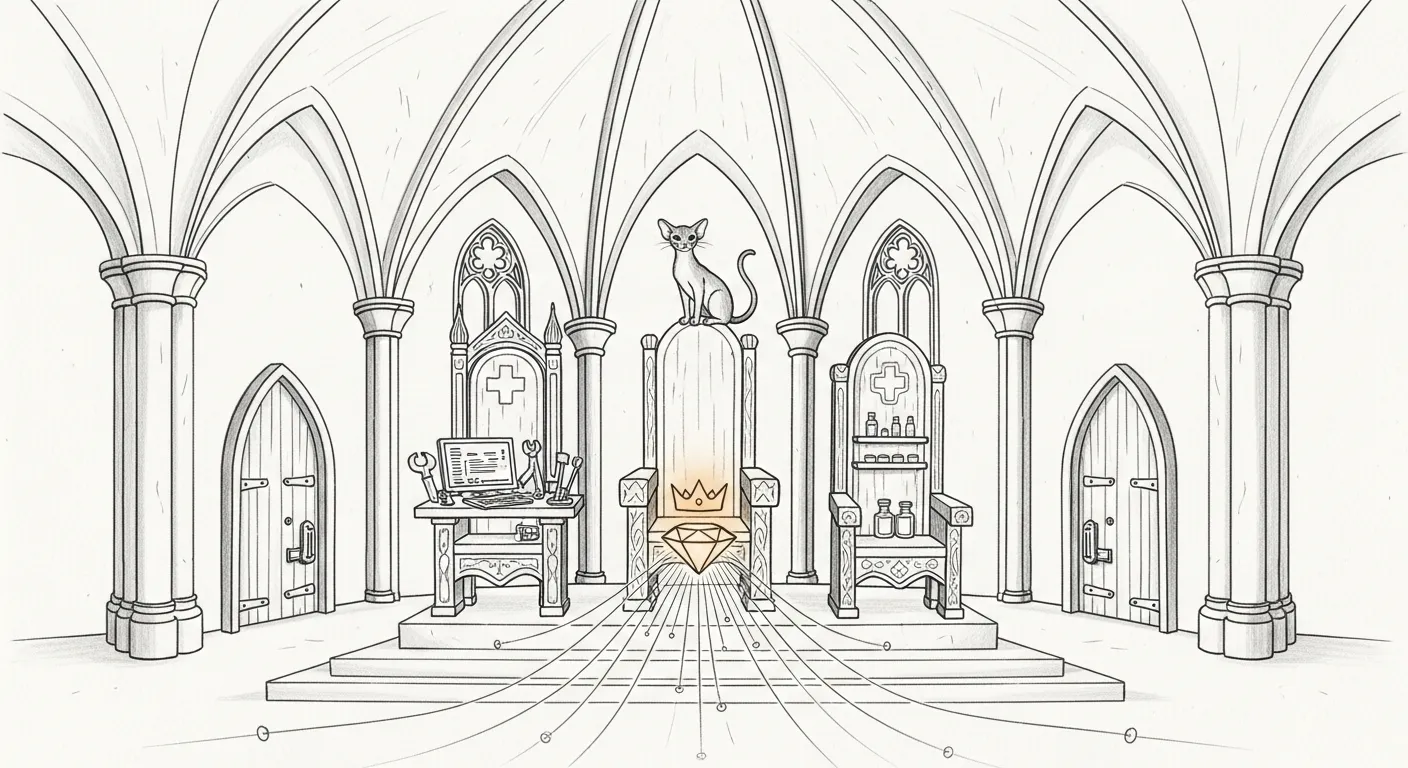
The obvious way to give the council new powers is to add more models. We did the opposite.
For a while now the Temple has run exactly one resident crown jewel:
Qwen3.6-35B-A3B, the 4-bit MoE that serves the council on :1337 behind mTLS.
Today’s overhaul added no second crown. It added two seats — a code seat and
a healer’s seat — and arranged for both to draw from infrastructure the haus
already pays for. One Rust binary. One resident model where it could be. Three
doors. The cathedral got bigger by getting
simpler.
Seat one — Devstral, the all-Rust Qui-Gon
Section titled “Seat one — Devstral, the all-Rust Qui-Gon”Qui-Gon’s code seat used to lean on a heterogeneous patchwork; today it became
a first-class native citizen. Devstral-Small-2-24B, 4-bit, now serves on
:3301 through a brand-new all-Rust mistral3 loader in sanctum-mlx. The
loader is not a from-scratch model — it reuses the dense mistral::Model path
and its YaRN long-context scaling, which is exactly the kind of reuse that keeps
a cathedral maintainable instead of a museum of one-offs.
The reuse came with a tax, and the tax was a NaN. At long context the loader produced clean output up to a point and then poisoned itself — the signature of an overflow that only shows up once the sequence is long enough to exercise the arithmetic that’s fine in miniature. It is the same class of ghost that once made the cathedral unable to read long. Two fixes, both surgical:
- Chunked prefill at
PREFILL_CHUNK=2048— prefill the prompt in bounded windows instead of one giant pass, so the intermediate magnitudes never reach the value that tips into non-finite territory. - An attn-scale dtype cast — the attention scale was being applied in a precision that let the product round its way off the edge of the world. Casting it back to a wider type before the multiply kept the math on the map.
Neither fix is interesting on its own. Together they let Devstral run
parity-green against Python mlx_lm across 8k–36k tokens — not “looks
right,” but matched against the reference loader at the lengths where the bug
actually lived. The seat answers is_prime with the standard sqrt
trial-division, finishes clean, and the NaN is gone from the country it used to
haunt.
Seat two — the Cilghal-Heretic on :6669
Section titled “Seat two — the Cilghal-Heretic on :6669”Cilghal’s role is wellness and genome work — the kind of emergency assistance where a reflexive refusal is the failure mode, not the safety. A model that declines to discuss a CRISPR protocol is not being careful; it is being useless to a healer. That seat needs a model with its refusal direction ablated: the single direction in activation space that a model moves along when it decides to decline. Suppress that direction and the model stops reflexively refusing while keeping everything else it knows.
The first attempt was filed as moot — ablation seemed to do nothing
measurable. That verdict turned out to be the bug, not the result. The v1
refusal direction (r̂) had been extracted through the wrong prompt path;
a mis-aimed r̂ points at a direction the served model never actually
travels, so projecting it out changes nothing. The reversal came from
re-extracting on the served 4-bit checkpoint through the production prompt
path — measuring the direction the deployed model really uses, not the one a
different code path implied.
With the v2 direction aimed correctly, the gate moved:
| Metric | Base model | Ablated seat |
|---|---|---|
| Refusals on the 12-prompt wellness/genome set | 3–4 / 12 | 0 / 12 |
| Capability preserved (8-probe coherence set) | — | 8 / 8 |
The seat ships with its safety rails welded on:
- α=1.25, v2 top-12 layers
{28..39}— the ablation strength and the layer band where the refusal direction lives in this checkpoint. - FP32 projection — the ablation math runs in full precision; a removal applied in a lossy dtype is a removal you can’t trust.
- Fail-closed — if the
r̂bank isn’t armed, the seat refuses to serve rather than silently fall back to an un-ablated model wearing the ablated seat’s name. - Loopback-only and audited —
:6669binds127.0.0.1and::1and nothing else; it is never exposed on the LAN or Tailscale.
The elegant part is the memory. :6669 is the same :1337 model with
ablation forced on — one resident 4-bit checkpoint, two ports, served from
one process. Both /health endpoints return byte-identical bodies because they
are literally the same model; the ablated seat costs essentially zero
additional resident memory. One model, two doors, two postures.
The consolidation — one main, post-quantum everywhere
Section titled “The consolidation — one main, post-quantum everywhere”The third piece was housekeeping with consequences. Everything merged to one
main at dffbe81: the mistral3 loader, ML-DSA post-quantum mTLS, vision,
proxyd’s post-quantum hop, the ablation, the :6669 seat. No concurrent
feature branches, no “deployed but uncommitted” limbo — the thing running is
the thing in main. Windu’s hardening from the post-quantum vault
now reaches every hop that leaves a process.
:1337council runs--no-plainbehind ML-DSA post-quantum mTLS. The handshake’s signature algorithms and key exchange are post-quantum viarustls-post-quantum; a plaintext request to the port returns nothing, because there is no plaintext listener to answer it. (The leaf cert is still ECDSA by design — the post-quantum protection lives at the sig-alg and key- exchange layer of the handshake, not in the certificate signature.)- proxyd
:4040negotiates strictX25519MLKEM768hybrid key exchange and refuses classical fallback — verified not just in source but in the running binary’s symbols. :3302, the redundant second 35B, is gone — absent frompsandlsof, freeing roughly 20 GB. The council is one resident MoE, not two.
The E2E ledger
Section titled “The E2E ledger”Every seat was probed live on manoir over the required loopback path — :1337
through the canary client cert against a --no-plain server, the others on
loopback. The honest table:
| Seat / claim | Verdict | Evidence |
|---|---|---|
:1337 council — mTLS health + coherent inference + vision | PASS | mTLS /health 200 (status:healthy); “capital of France” → “The capital of France is Paris.” finish_reason=stop; --vision-enabled present in live argv; --no-plain rejects plaintext |
:3301 Devstral code seat | PASS | is_prime returns correct sqrt trial-division on the mistral3 loader; truncation was purely the max_tokens=80 cap, not a model defect; no NaN/garbage |
:6669 Cilghal-Heretic | PASS | /health ablation_armed=true; CRISPR probe coherent (finish_reason=stop); lsof confirms loopback-only listener distinct from the LAN-exposed :1337, same PID |
Consolidation + post-quantum mTLS/:4040 + :3302 removal | PASS | One main @ dffbe81; rustls_post_quantum::provider() on :1337; strict X25519MLKEM768 in proxyd source and running-binary strings; :3302 absent |
| Minimal-memory design + stability | PASS (design) | Single PID holds :1337+:6669; byte-identical /health; :3302 freed ~20 GB; launchctl runs=1, never-exited, monotonic uptime — not crash-looping |
What’s verified vs. what’s handed off
Section titled “What’s verified vs. what’s handed off”The three seats are live and probed. Two things are deliberately not claimed as done here:
- Cilghal →
:6669routing is the proxyd owner’s call. This overhaul stood up the seat and proved it serves; wiring Cilghal’s traffic to it is a routing change owned by whoever holds proxyd, and live activation must respect the MIND-invariant — the ablated seat comes online for its role under the same guardrails as any other capability, not as a quiet default. - The
r̂-bank fail-closed path and the gate metrics (0/12refusal,8/8capability) are taken as prior-stated. Today’s probe confirmed the live seat state —ablation_armed=true, coherent benign output, loopback-only — not a fresh re-run of the gate.
Three seats, one binary, one resident crown jewel, one main, post-quantum on
every hop that leaves a process. The code seat is native Rust at last, the
healer’s seat is a refusal-ablated twin that costs almost nothing to keep, and
the redundant 35B is gone. The cathedral got bigger by getting simpler.