

The map caught up to the territory
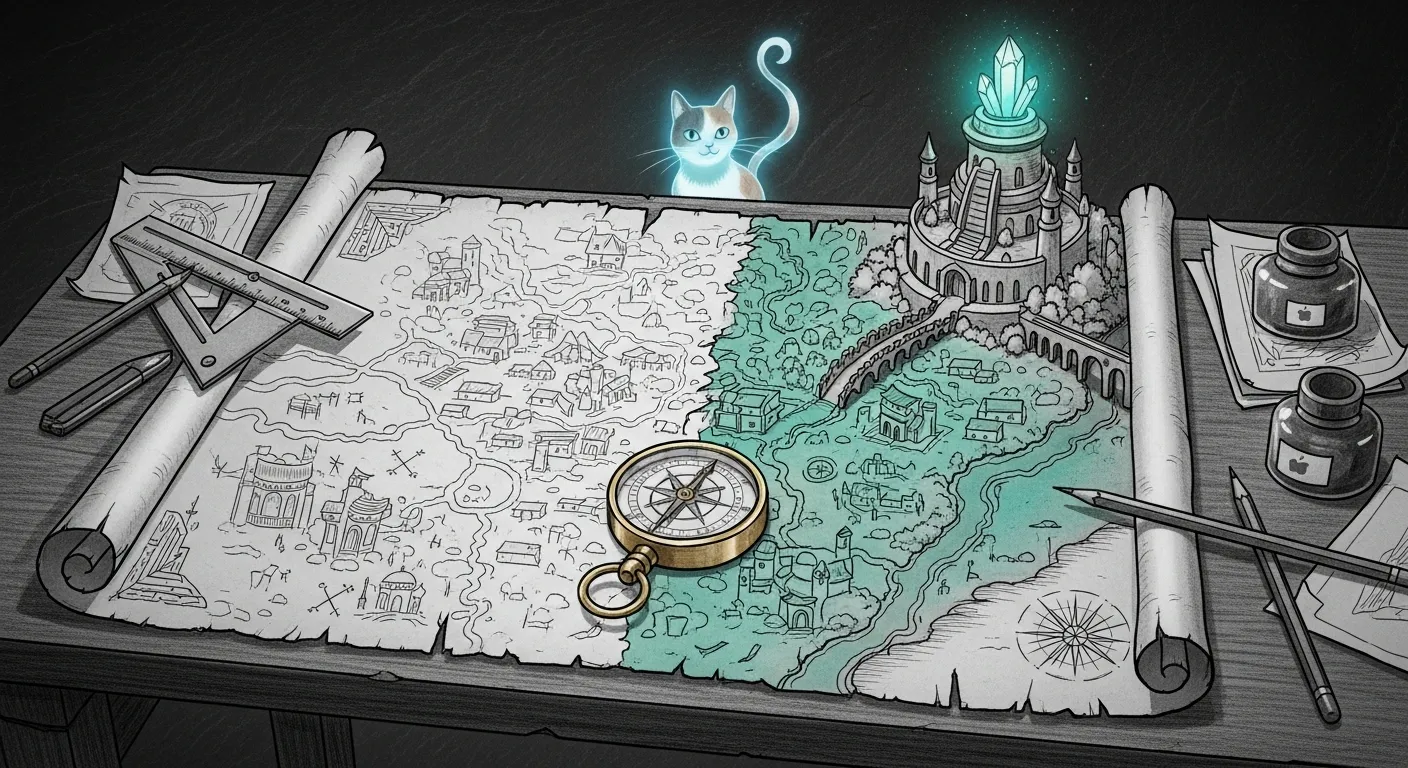
Nothing was down. That was the trap.
The Documents→Projects migration had landed weeks of drift in one night’s lap. The health registry read all-pass, the watchdog’s damped INFO noise had been stable for weeks, every service answered its probe. But the map — instance.yaml, the runtime catalog, the service manifests, the test suites — now described a haus that no longer existed. This is the field note from the night we made it catch up.
The shape of the drift
Section titled “The shape of the drift”The drift lived one layer up, in the declarations. Everything underneath was healthy; every line that named it had quietly gone stale. We had to read all of them:
- The renderer pruned what it didn’t know.
render_runtime_services.pywrites the full manifest set and removes strays — so the hand-authored manifests forendocrine-glandand the oldsanctum-ttsvanished on the first post-migration render. Both services were alive; both were unmonitored the moment the render ran. - The catalog had renamed a doctrine-constant. The pre-rename
sanctum-ttsmanifest carried an explicit header: the public namesanctum-ttsand port 8008 stay constant across backend transitions. The rescue-commit catalog inverted it —qwen3-ttsbecame the node name and the doctrine name disappeared, which is exactly what the runtime-audit graph spec was written to catch. - The vm was modeled as qemu. The catalog’s health check looked for a
qemu-system-aarch64process. The VM has run under OrbStack since the qemu retirement; the watchdog dutifully “healed” a VM that was never sick by kicking a launcher for a hypervisor that no longer exists. - The tunnel that OrbStack made obsolete.
ha-tunnelkept a supplemental catalog entry (and so a manifest, and so watchdog noise) long after OrbStack started mapping:8123natively. - The dashboard’s ports were a fossil record. instance.yaml declared
dashboard: 3333andcommand_center: 1111— two entries, two stale ports, one actual node process serving both the Jocasta shell and the Command Center API on:3002behind a passkey gate. (Which also resolves the June 12 audit note: the gate is ENFORCING.)
What the fix looked like
Section titled “What the fix looked like”We taught the renderer two small
doctrines. provides: aliases are now
first-class dependency tokens, and an override may pin a public name: —
so sanctum-tts renders under its constant name with qwen3-tts as the
back-compat alias, and every requires: list that referenced either
resolves. endocrine-gland moved from hand-authored stray to cataloged
supplemental, command-type freshness checks intact. The vm entry now
models OrbStack: liveness is ssh reachability on the stable vmnet anchor,
healing goes through orbstack-autostart.
Forty-four manifests render clean, --check idempotent.
The tests had drifted too
Section titled “The tests had drifted too”Half the “failures” were suites asserting the previous world: plain-HTTP
probes against the mTLS-only Temple
(Fort Knox hardening, July 5 — no
plain listener, client CA required), an http probe against the Rust
proxy’s https, a last_ingested field the health-center API renamed to
has_data, an LM Studio bridge assertion for a stack decommissioned in
June, and a “VM reaches mac MLX” check that Fort Knox deliberately closed
(the VM holds no client cert; VM workloads ride cloud providers via the
gateway). Each assert we moved to the verified present rather than
deleted — the mTLS probe now uses the canary client cert minted for
exactly this purpose.
The watchdog’s ghosts
Section titled “The watchdog’s ghosts”sanctumd carries one ghost in its compiled body: a Living Force
roll-call that loads qwen2.5-coder-14b through LM Studio on :1234 —
dead architecture walking, flagged lmstudio-coder14b unhealthy every
ten minutes for weeks. It is env-gated (LIVING_FORCE_COUNCIL_ENABLED),
so the staged watchdog plist now ships it false; the ghost goes silent
at the next clean lifecycle. Porting the roll-call to the mTLS Temple
seats is sanctum-rs work for
another night.
The board work: the Holocron sidecar wanted three greens. The LinkedIn monitor already knew how to say SKIPPED honestly; the OBLITERATUS monitor learned the same doctrine (an on-demand research app that isn’t running is not running, not breached — static integrity check instead). Disk pressure cleared from 87% to 82% by deleting exactly two cold, unreferenced, re-downloadable public model caches — 47 GB of Ornith and a Heretic duplicate in the decommissioned LM Studio cache.
Where it ended
Section titled “Where it ended”Every suite green: sanctumctl 39/0, runtime-audit 31/0, system-e2e 39/0, sanctum-audit 89/0, evolution-loop 15/0, tech-lookout 14/0, kitchen-loop 19/0, pytest 107/0. Registry 41/41. Watchdog root causes: empty. Holocron: OPERATIONAL, kyber green.
The lesson worth keeping: after a migration, the dangerous drift is not the service that fails — it’s the declaration that still describes the old world while everything underneath it moved. Render from one source of truth, make the renderer refuse what it can’t verify, and let the test suites assert the present tense.
The haus never went dark. It just spent a few weeks being described by a map of somewhere it used to be. By sunrise the two agreed again, and we went to bed trusting the territory.