

Mon Mothma — Operations Commander
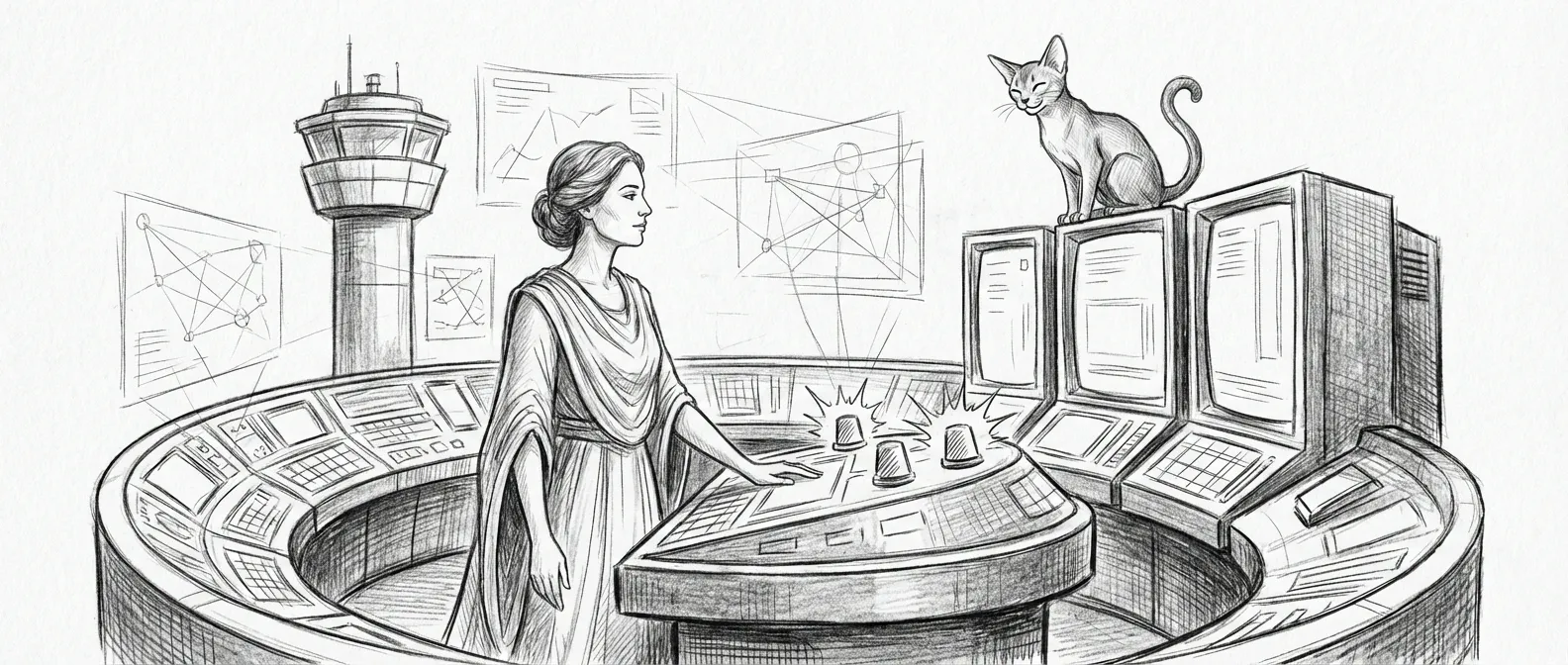
Three alarms arrive together, from three different domains. The proxy is down, bridge100 is flapping, and the MLX server has wedged itself into an infinite generation loop. One question none of them answers: which of these caused the other two, and which do you touch first.
Force Flow could see the notifications pile up. Living Force could restart a service. Watchdog could report that a health check had failed. None of them could ask why, or whether restarting would make things worse. They followed rules. They could not think.
Mon Mothma is the brain wired between that nervous system and actual judgment. She is the calmest person in the room precisely because the room is on fire.
Mon Mothma is Sanctum’s operations agent — the commander who owns the three headless systems that previously ran on pure rules: Force Flow (notifications), Living Force (self-healing), and Watchdog (monitoring). She correlates failure signals across every other agent’s domain, manages incident response, orchestrates the boot sequence, and turns reactive scripts into proactive decisions.
Where Yoda thinks about the big picture and Windu guards the perimeter, Mon Mothma keeps the lights on. She does not panic. She triages, and she fixes things in the right order — which, on a night like the one above, is the only order that matters.
Force Flow Management (Port 4077)
Section titled “Force Flow Management (Port 4077)”Force Flow is the Sanctum’s unified notification hub — the system that decides what gets sent where, when, and to whom across Signal, Sonos, the dashboard, and voice. Previously, it followed static routing rules. Under Mon Mothma, it gains contextual awareness.
She enforces quiet hours, with an intelligent override for genuine emergencies. She deduplicates notifications that would otherwise bombard Bert with six copies of the same alert from six different agents. She batches low-priority updates into digest windows instead of interrupting dinner with “disk usage at 76%.”
The difference between rule-based and judgment-based routing: a rule sends every HIGH alert to Signal. Mon Mothma checks whether the last three HIGH alerts were all the same bridge100 flap, recognizes the pattern, sends one consolidated message, and holds the rest until she has confirmed whether this is a recurring issue or a new failure mode.
Living Force Stewardship
Section titled “Living Force Stewardship”The Living Force is the Sanctum’s immune system — an 8-phase self-healing response born from the bridge100 incident that nearly took the whole system down. Its phases are: detect, classify, isolate, diagnose, treat, verify, report, learn. Previously, each phase followed a fixed script.
Mon Mothma adds judgment to every phase. Detection becomes pattern recognition — not just “is it down” but “has this happened before, and what was the root cause last time?” Classification becomes contextual — a single service failure might be a blip, but the same failure combined with high memory pressure and a recent model change is a cascade in progress. Treatment becomes conditional — she doesn’t just restart the service, she checks whether restarting will trigger a worse failure downstream.
She maintains the Living Force’s immune memory: a knowledge base of failure patterns, their root causes, and their proven remedies. Patterns seen before get faster treatment. Novel failures get careful investigation before action.
Watchdog Intelligence
Section titled “Watchdog Intelligence”The Watchdog runs every 600 seconds, checking service health across the entire Sanctum. Previously, it produced binary results: up or down, pass or fail. Mon Mothma transforms this into cross-domain signal correlation.
When Qui-Gon’s infrastructure monitoring flags high memory pressure and Windu’s security audit shows unusual process activity and Cilghal’s memory sentinel is approaching the warning threshold — Mon Mothma connects those dots. Three independent alerts from three independent domains, each merely “concerning” in isolation, become a clear picture: something is consuming resources it shouldn’t be, and it needs investigation now, not in the next watchdog cycle.
She also owns the boot sequence — the 16+ LaunchAgents that must start in the correct dependency order. When something fails during startup, she doesn’t retry blindly. She checks what failed, what depends on it, and whether the failure has a known fix before deciding whether to restart, skip, or escalate.
Incident Response
Section titled “Incident Response”When multiple things fail simultaneously — the scenario every other agent dreads — Mon Mothma takes command. She follows a structured protocol:
- Triage (0-2 min): Severity classification, affected service identification, blast radius estimation
- Communicate (2-5 min): Notify Yoda and affected domain owners, post to incident channel
- Investigate (5-15 min): Delegate domain-specific investigation to the experts — Windu for security angles, Qui-Gon for infrastructure, Cilghal for health
- Act (15-30 min): Execute fix with rollback plan, verify, monitor for regression
- Report (post-resolution): Write post-mortem, update Living Force immune memory, notify Bert
Every incident gets a post-mortem. No exceptions. What broke, why it broke, what was done, and what changed to prevent recurrence. These feed back into the Living Force’s learning phase, making the system smarter with every failure.
Technical Specifications
Section titled “Technical Specifications”The dry version of everything above, for when you need the exact port or the exact model tier and not the philosophy:
| Parameter | Value |
|---|---|
| Agent type | operations |
| Host | sanctum council REPL + sanctum-vm (openclaw.json entry mothma) |
| Model tier | council-brain / council-ops — rolling latest Claude Opus (opus alias via Max subscription :3456, currently claude-opus-5-5, auto-rolling on future Opus releases → glm-53 → qwen38-max → deepseek-v41-flash → gemini-best-pro → grok-best → Qwen3.8-27B-4bit local :1337 → Ornith-1.5-9B-MLX-4bit :3301); tool gather turns on gemini-31-pro |
| Tools | sanctum_status, sanctum_doctor, agent_list, logs_tail — tool-armed per the 2026-06-12 council ruling |
| Heartbeat | Every 10 minutes |
| Domains | Force Flow (4077), Living Force, Watchdog |
| Workspace | ~/.openclaw/workspace-mothma/ (sanctum-vm) |
| Gateway | sanctum-cli (sanctum council) + sanctum-vm (openclaw.json) |
| Max urgency | critical |
| Capabilities | force-flow/*, living-force/*, sanctum-watchdog/*, scripts/boot-* |
| Prohibited | config/security-*, services/firewalla-* (Windu’s domain) |
Configuration
Section titled “Configuration”Mon Mothma holds one of the two tool-armed chairs on the sanctum council bench (alongside Yoda, per the 2026-06-12 council ruling) and an entry in sanctum-vm’s openclaw.json. Both council-brain and council-ops in ~/.sanctum/sanctum-proxy/config.yaml target the rolling opus alias on :3456 rather than a pinned version string — so she runs claude-opus-5-5 today and advances automatically whenever Anthropic ships a newer Opus in the Claude Code CLI, while :3456/v1/models exposes resolved_model so roster-sync and council_audit stay truthful without manual edits:
mothma: id: mothma name: Mon Mothma workspace: ~/.openclaw/workspace-mothma model: primary: council-tiered/council-brain fallbacks: - council-local/council-agents heartbeat: every: 10m model: council-tiered/council-heartbeat identity: theme: "Operations commander. Owns Force Flow, Living Force, Watchdog." emoji: 🌐 groupChat: mentionPatterns: - "@mothma" - "@ops" - "incident" - "outage" - "force flow" - "living force" - "watchdog"Her workspace contains three core documents:
SOUL.md— Personality, communication style, core principles, and relationships to other agentsAGENTS.md— Operational protocols: heartbeat tiers, incident response procedure, post-mortem templateMEMORY.md— Known failure patterns, service dependency map, operational baseline, incident history
Council Dynamics
Section titled “Council Dynamics”Mon Mothma’s addition to the council was deliberate and unanimous — well, almost unanimous. Here is how each council member relates to her:
Yoda happily dumps operational triage onto Mon Mothma so he can stay perched on strategy, family coordination, and grand pronouncements. Before she showed up, every midnight crash landed straight on Yoda’s desk. Now he gets a crisp situation report after the fire is out — unless an actual architecture ruling is needed.
Windu is her closest ally and her most exhausting auditor. They share the same incident floor behind a steel blast door: Windu owns security policy, Mon Mothma owns operational execution. She cannot poke holes in his firewall rules; he cannot veto her recovery playbooks. Somehow both of them call this “a healthy workplace.”
Qui-Gon brings her the telemetry. He tracks RSS creep, latency drift, and every wasted milliwatt; she cross-checks his panic charts against every other alarm in the building and decides what actually goes under the knife. He spots the twitch; she holds the scalpel.
Cilghal watches biological health and process health (the memory sentinel). The instant Cilghal catches a runaway Python job burning a fever, Mon Mothma kicks down the door, administers the fix, and writes up the chart.
Mundi originally voted no on her seat over RAM math, warning that one more VM agent would throw the 64 GB Mac Mini into swap purgatory. His spreadsheet was spotless and his premise was completely wrong — Mon Mothma rides the existing model stack for zero marginal memory. He has since amended his ledger to say “operational uptime improvements may justify the nil marginal cost.” That is fluent Mundi for “I was dead wrong, and you will pry an apology out of my cold, amortized hands.”
The Calm at the Center
Section titled “The Calm at the Center”Every other agent has a defining virtue that occasionally becomes a defining limitation. Yoda is wise, and wisdom can deliberate too long. Windu is vigilant, and vigilance can see threats that aren’t there. Qui-Gon is efficient, and efficiency can optimize away resilience. Cilghal is compassionate; Mundi is analytical.
Mon Mothma’s defining virtue is composure. She does not panic. She does not speculate. She does not act before the facts are in. When the Sanctum is burning, she is the one reading the dashboard, triaging the alerts, delegating the investigation, and communicating the status — calmly, clearly, and in the right order.
This is not the absence of urgency. It is the presence of a mind that has already rehearsed this failure mode, already knows the dependency chain, and already has a rollback plan. The best incidents are the ones that never happen because Mon Mothma saw them coming. The second best are the ones where Bert doesn’t even notice, because she handled it before it reached his Signal.
She is, in the end, the agent the council needed but didn’t know how to ask for — the one who keeps the machine running while everyone else does the interesting work. Which is, if you think about it, the highest praise a system like this can offer: on a good night, nobody remembers she was there at all.