

2026-07-03: The Doubly-Synced Git
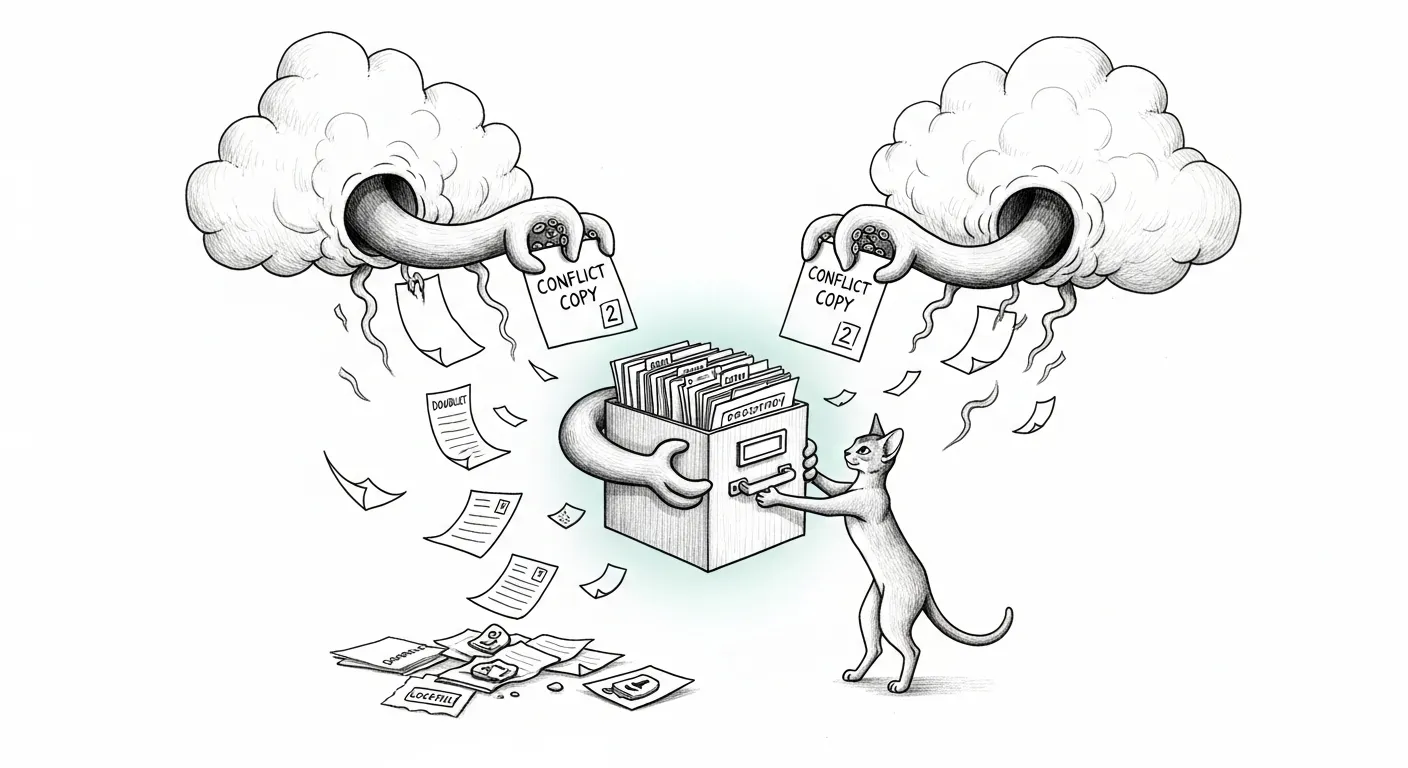
Some bugs announce themselves. This one wore a mask and changed it nightly.
The workspace repo — the one that holds this very site as a submodule — kept
rotting. We would open it one morning to find 460 files staged for
deletion, including .gitignore, CLAUDE.md, and the submodule pointers. The
next session would find HEAD sitting on a commit from two months ago, as
if the last sixty days of work had never happened. And through all of it, a
.git/index.lock kept reappearing — clear it, and twenty minutes later it was
back, a corpse that would not stay buried.
Each symptom had a plausible, wrong story attached. The mass deletion looked
like a stray git rm --cached -r .. The rolled-back HEAD looked like a bad
reset. The recurring lock looked like a git process that kept crashing
mid-write. We even blamed OneDrive — the folders were right there in the sidebar.
Every one of those stories was a symptom mistaken for a cause.
The one command that named the killer
Section titled “The one command that named the killer”The break came from trying to do the most boring thing possible — fetch:
$ git fetch originfatal: bad object refs/heads/main 2refs/heads/main 2. A file-sync service had reached inside the .git
directory and made a conflict-copy of a git ref file — the pointer that says
“this is where main is.” Git tripped over the impostor and refused to move.
Pull the thread and the whole sweater comes off: .git/index 2,
.git/refs/remotes/origin/main 2, packfile 2.idx, submodule .git/modules/*/index 2,
and — the smoking gun for the horror-movie lock — .git/index 2.lock. The
“stale lock that kept coming back” was never a crashing process. It was a cloud
engine faithfully syncing a lockfile between two machines.
The real root cause: two clouds, one .git, two machines
Section titled “The real root cause: two clouds, one .git, two machines”~/Documents was not just any folder. On both the laptop and the Mini it
carried the xattr com.apple.file-provider-domain-id = com.apple.CloudDocs.iCloudDriveFileProvider — the fingerprint of iCloud Drive’s
“Desktop & Documents Folders” sync, the same domain UUID on both machines.
And iCloud was not working alone: Google Drive was churning the same tree —
2,242 .tmp.driveupload staging files on the laptop, 9,875 on the Mini.
So the repo lived inside a folder that two independent cloud engines were both
syncing, from two computers, in real time. A git repository is a database of
thousands of tiny, order-dependent files that must be written atomically and
owned by exactly one writer. Cloud sync offers the opposite of all three: it
copies files out of order, resolves collisions by duplicating them, and
dematerializes the ones it thinks are idle. The " 2" copies were iCloud’s
handwriting; the bare-numeric orphans were Google Drive’s. The repo was not
broken. It was being helpfully eaten.
The migration, and the trap the council caught
Section titled “The migration, and the trap the council caught”The fix is a relocation, not a repair — iCloud’s Desktop & Documents sync has no per-folder opt-out, so you cannot exclude the repo in place. Move it out and re-clone fresh from GitHub, on each machine independently. But “re-clone fresh” quietly means “delete the working copy,” so the discipline is all in what you rescue first:
- Freeze the tree (a vault heads-up + acks, not a unilateral cutover), then
git bundle --allboth the parent and every submodule — the reversible backstop. - Rescue every dirty submodule’s genuine work, not just the obvious one. A
naive re-clone would have silently deleted a
triptyq-tearsheetsCSV of real CRM corrections and four unpublished field-note assets in this repo — neither was on any remote. - Verify before you retire. The new clone had to pass
git fsck, a HEAD check, a blob-hash oracle (the rescued files must reproduce their exact object hashes), directory counts, and a “zero conflict-copies, no file-provider xattr” gate — before the old copy was allowed to move. - Repoint, then let the old copy live as a ≥7-day backstop. The laptop had 6 references to the old path; the Mini — the server — had 44, across two daemons and ~26 service definitions.
The sharpest save was one the council’s adversarial reviewer made. The naive
plan wanted to push a diverged submodule’s local commit “to be safe” — a git push that would have been a non-fast-forward and, if forced, would have
destroyed two commits that existed only on the remote. A single git patch-id settled it: the local commit was byte-for-byte a duplicate of a
commit already upstream. No push. No force. No loss. Falsify before you fortify
— even when the plan is your own.
Once relocated, work lands the one sanctioned way — through
gitsync, which enforces the pathspec discipline so a
sweep from one machine never rides along on another session’s commit. This was
not the first time the workspace hid something in plain sight; it once buried
two stones in a Cargo.toml
that compiled clean and inferred nothing.
The repo now lives at ~/Projects/Claude_Code on both machines, non-synced,
verified, with every rescued byte in place. The thing that kept eating it is no longer in
the room.