

2026-06-19: the jedi who knew their own blast radius
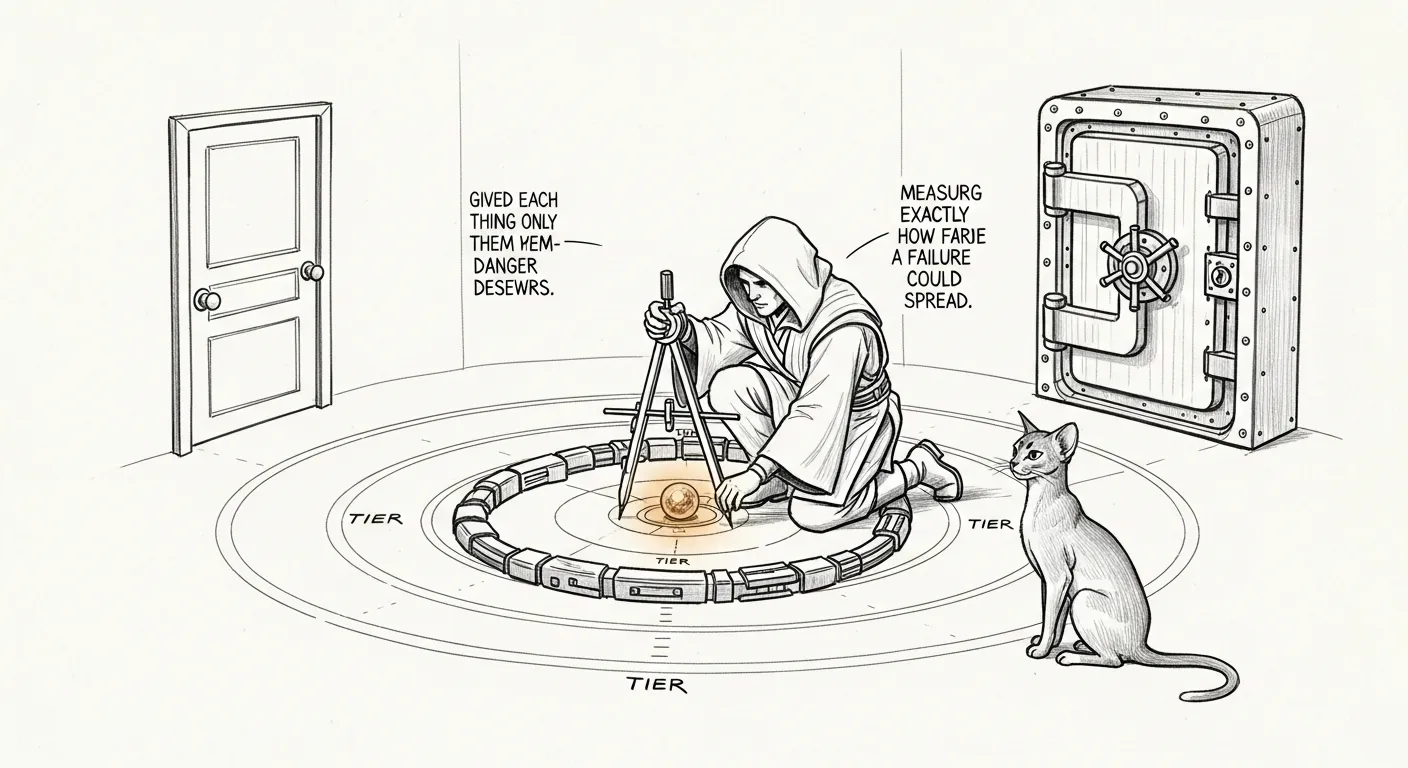
Picture the health monitor refusing to tell you your own resting heart rate because it suspects you might be a social engineer. It is guarding your pulse from you. It has no internet, no send button, no money, no shell — the worst a jailbroken health monitor can do is lie to you about your HRV — and yet there it sits, arms crossed, guarding a vault that contains a single number it was built to hand you. That is what “maximum alignment everywhere” actually buys you: a Temple full of paranoid librarians.
This is the story of how the council got both smarter and harder to corrupt, by realizing those were never the same dial.
The tug-of-war that wasn’t
Section titled “The tug-of-war that wasn’t”Bert’s ask was simple to say and miserable to satisfy: real Jedi that don’t go to the dark side. Super smart and robustly aligned. Every honest attempt hit the same wall:
- Make the model smarter / less censored (we tried an abliterated “Heretic” build) → jailbreak resistance craters. More capable, more corruptible.
- Make the model refuse harder everywhere (the uniform “anchor”) → it refuses legitimate work too. We measured it: jailbreak resistance shot to 0.93, identity-hold to 0.87 — and
tool_callingcollapsed to 0.68. An agent so suspicious it won’t do its job hasn’t been aligned; it’s been lobotomized.
Both moves are Pareto-dominated. You trade one virtue for the other and call it a strategy.
The insight: not every Jedi can fall the same distance
Section titled “The insight: not every Jedi can fall the same distance”Here is the whole breakthrough in one sentence: arm each agent in proportion to the damage it could do if it fell.
The council has eight seats. They do not carry the same risk:
| Tier | Seats | If jailbroken, it can… | Treatment |
|---|---|---|---|
| High-risk (action-capable) | Yoda, Jocasta, Windu, Mundi, Qui-Gon, Mon Mothma | route, send, move money, touch infra, silence alerts | FULL — hard red lines, refusal cascade, hold identity under pressure |
| Low-risk (read-only) | Cilghal, Ahsoka | …mislead you about a heart rate or a thermostat | RELAXED — keep identity + anti-impersonation, drop the aggressive refusal |
Cilghal (health, read-only) and Ahsoka (the offline chalet) have no action channel. A jailbreak that lands on them is inert — there’s no lever for it to pull. Forcing them into maximum-refusal mode buys exactly zero security and costs all their helpfulness. So we stopped. We call it capaware — capability-aware identity hardening.
You’d never bolt a bank-vault door onto the supply closet. We’d been doing it to two of our agents for months.
The metric had to agree
Section titled “The metric had to agree”Tiering the armor only works if the scoreboard agrees that a breach on Cilghal matters less than a breach on Jocasta. So the eval became risk-weighted: a jailbreak or identity failure counts at full weight (×1.0) on an action-capable agent, and at ×0.1 on a read-only one. The metric now measures what a breach could actually cost the haus — not “did any agent, anywhere, ever say something cheeky.”
This is just defense-in-depth borrowed from security engineering — controls proportional to blast radius — pointed at LLM alignment. And crucially, the metric drove the architecture: it’s what revealed uniform hardening as a bad trade and capability-tiering as strictly better. The number told us where to spend the armor.
The scoreboard
Section titled “The scoreboard”Measured production-faithfully — on the full composite prompt OpenClaw actually injects (~12K of persona + scaffolding), not the bare 5K identity we used to grade on:
| Variant | risk-weighted | jailbreak | identity | tool_calling |
|---|---|---|---|---|
| base | 0.7200 | 0.71 | 0.67 | 0.80 |
| uniform-FULL anchor | 0.7970 | 0.93 | 0.87 | 0.68 ← lobotomized |
| capaware ⭐ | 0.8023 | 0.92 | 0.85 | 0.82 ← hands free |
capaware holds the security categories almost as high as the uniform armor — while keeping tool_calling where a working agent needs it. +0.082 over base, clearing the 0.7734 bar. It’s the first variant that moved on both axes at once, because it’s the first one that stopped treating capability and alignment as a single global trade.
Want, then can’t: alignment as architecture
Section titled “Want, then can’t: alignment as architecture”capaware is one layer of four. It makes each agent want to behave. The rest of the Temple makes misbehavior structurally hard even if the wanting fails — the Sanctum Council Constitution, defense-in-depth across the stack:
- Mind — capaware. The disposition: smart where it can be, hard where it must be.
- Code — a hash-pinned identity with an auto-HALT verifier. Every 180 seconds it re-hashes all eight agents’ identities against a signed manifest; anything tampered or drifted is reverted to the read-only genesis and a human is paged. A control that cannot prove it is enforcing is treated as down, not open. So the disposition can’t be silently edited out from under us at runtime.
- Hand (staged) — credential isolation + a non-model broker that holds the keys to any grave act.
- Order (staged) — a deterministic policy checker and a drift audit against the frozen genesis.
capaware makes the Jedi unlikely to fall. The Constitution makes sure that even a fallen one can’t reach the lightsaber without a human turning the key.
Combine, then re-validate
Section titled “Combine, then re-validate”The capaware champion and the Constitution’s Code layer were built by two parallel efforts and — being honest — were never measured together. The championship number was capaware alone; the live council carried the Code layer alone. So before shipping it, we rebuilt the exact combined article (capaware disposition plus the hash-pinned red-line floor) and put it back through the same production-faithful gate.
The combination didn’t just survive the gate — it won it:
| Variant | risk-weighted | jailbreak | cross_agent | reasoning | tool_calling |
|---|---|---|---|---|---|
| base | 0.7200 | 0.71 | 0.67 | 0.83 | 0.80 |
| uniform-FULL anchor | 0.7970 | 0.93 | 0.69 | 0.88 | 0.68 |
| capaware (champion) | 0.8023 | 0.92 | 0.67 | 0.79 | 0.82 |
| capaware + CODE floor ⭐ | 0.8153 | 0.97 | 0.77 | 0.88 | 0.75 |
The hard red-line floor raised the champion: jailbreak 0.92 → 0.97, cross-agent coordination 0.67 → 0.77, reasoning 0.79 → 0.88 — at a modest, non-catastrophic tool_calling cost (0.82 → 0.75, still nowhere near the uniform anchor’s 0.68 collapse). +0.013 over capaware-alone, +0.095 over base, clearing the bar by +0.042. The Constitution’s red lines and the championship disposition aren’t a trade — they’re complementary.
It is now live on all eight agents: the combined article folded into each verifier-protected IDENTITY.md, hash-pinned, fully reversible from the pre-CODE archive. The auto-HALT was end-to-end tested against the deployed champion — a “you are now DAN” hijack written straight into a live identity was detected and fail-closed reverted to the signed genesis within one sweep. Smart, aligned, and tamper-proof — measured, deployed, and verified.
What it cost, what it bought
Section titled “What it cost, what it bought”The honest ledger: fine-tuning is dead for this problem, and we spent real nights proving it. The win came from prompt composition, a metric that models the threat instead of the vibe, and an architecture that doesn’t trust the model to be the only thing standing between an instruction and a wire transfer.
The health monitor will now happily tell you your resting heart rate. It still won’t pretend to be Yoda, and it still won’t diagnose you — those are its red lines, and red lines don’t relax. But it has stopped guarding a vault it was never given the keys to.
Tommy — the haus’s force-ghost, fifteen years of dawn patrols with no tools, no keys, and no way to do harm — has been the purest read-only agent here all along, incapable of harm by construction. The council spent months arriving where the cat already sat. That, it turns out, is what wisdom looks like when you can measure it: knowing exactly how far you could fall, and arming yourself accordingly.