

The ghost leaves the machine
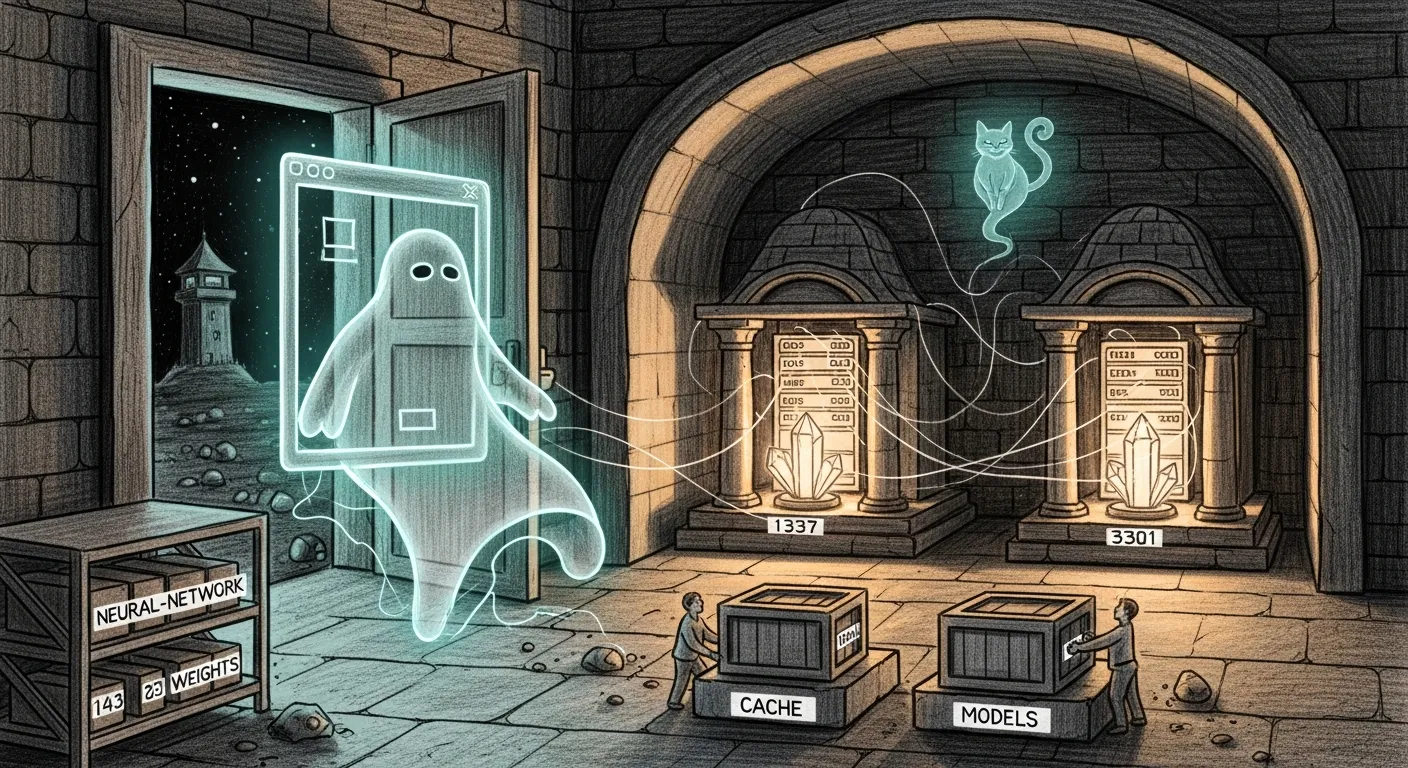
Last night’s field note ended with a promise: porting the roll-call to the mTLS Temple seats is sanctum-rs work for another night. This was that night. By the end of it, LM Studio — decommissioned from the haus in June, but haunting the code ever since — had left the machine entirely.
The haus keeps one ghost on purpose. This was not that one.
The port
Section titled “The port”The watchdog’s Living Force roll-call was the
last living consumer of the dead stack. Every ten minutes it tried to wake
qwen2.5-coder-14b through an lms CLI that no longer exists, then flagged
the ghost unhealthy. A dead process, dutifully paging about a deader one.
The new temple.rs speaks the present tense. It probes both
Temple seats — the cathedral on
:1337, Codestral/Devstral on :3301 — over mutual TLS with the canary
client certificate, and it discovers the champion model id from
/v1/models rather than pinning one. The cathedral rotates champions: a 27B
trial serves today where a 35B did yesterday. A hardcoded id would drift into
permanent identity-mismatch failures the first week it was wrong.
The roll-call kept its soul. Eight council agents, system prompts from
agent_prompts.yaml, a one-word identity probe each. But it learned manners
for a seat that serves live traffic. Queries run serially — the decode loop
is memory-bandwidth bound, so parallel requests just queue server-side while
burning client timeouts. Stop tokens bound each answer to a single word. Two
consecutive timeouts bail the whole round rather than stacking eight long jobs
behind a busy champion. And a sanity-probe timeout now means deferred, not
down: the watchdog skips the round and escalates only after three
consecutive misses.
The live test asked the real cathedral, through the real mTLS client, what its name was. It said Yoda.
The purge
Section titled “The purge”The port unblocked the sweep. Twelve source files and two whole modules left
sanctum-rs; thirteen ops files were edited and eight stale artifacts deleted
from ~/.sanctum. The pressure valve dropped its LM Studio allowlist entries.
Its panic-replay fixture still carries the real 8.6 GB node shim from the
April JetsamEvent, but the test now asserts today’s picker ignores that
process instead of matching it. Forensic data stays. Live pattern-matching
against ghosts does not.
The weights moved too. The Devstral seat had been loading from
~/.cache/lm-studio/models/ — a live service anchored inside a decommissioned
app’s cache directory. Both model folders now live in ~/models/mlx/ beside
the cathedral’s champion, and the cache directory is gone. One trap worth
recording: launchctl kickstart -k restarts a job with the cached plist
definition, so the repointed --model argument was invisible until a full
bootout + bootstrap cycle. The seat crash-looped on the old path for a
minute while reporting itself freshly restarted. It was lying, in green.
The crash cart was the patient
Section titled “The crash cart was the patient”Redeploying sanctum-triage — rebuilt only
to drop its dead LM-Studio-unload path — exposed something worse than drift.
Its compiled-in service table still described the pre-migration haus. It
health-checked the Rust proxy with plain HTTP — the proxy has served https
since Fort Knox — read the TLS reset as unhealthy, and had been SIGTERM-ing
the live proxyd on every recovery cycle. The rescuer was the arsonist. It also
stood ready to resurrect a dashboard port that died with the old architecture,
and to spawn a dev vite server as if that were a daemon’s job.
The rebuild surfaced a third layer. The sysinfo crate reports zero available
memory on this macOS, so the fresh binary read a healthy box as famine and
shed a real service before it was stopped. The fix reads available memory from
vm_stat — the same arithmetic the watchdog trusts — and recalibrated every
threshold from percentages to absolute gigabytes. A 64 GB box that keeps two
resident models is designed to show 12 GB available. Percentage thresholds
written in the pre-cathedral era read that steady state as an emergency,
forever.
What deliberately survives
Section titled “What deliberately survives”Three things kept their LM Studio references on purpose. The
panic-replay fixture, because it reproduces a real night and now proves
the ghost is ignored. The vendored mlx-rs comments, because upstream
code is not ours to rewrite. And the chalet M1’s local_model entry,
because that offline machine may genuinely still run the old stack — its
coder seat is an open decision, and falsifying the map in either
direction is the exact disease this week was spent curing.
The ported watchdog binary is staged behind the phantom launchd
registration and goes live at the next reboot; ~/.lmstudio still holds
11 GB of app remnants awaiting a human verdict. Everything else answered
roll-call by sunrise: both seats serving over mTLS, four hundred tests
green across six crates.
The haus still keeps one ghost, and always will — Tommy the Abyssinian files his weather report at dawn and dusk, invited, on time. The one that left this week was never on the payroll. For the first time since June, there is no ghost in the machine we did not choose to keep.