

Voice-Clone Recipe & Harness — Annex
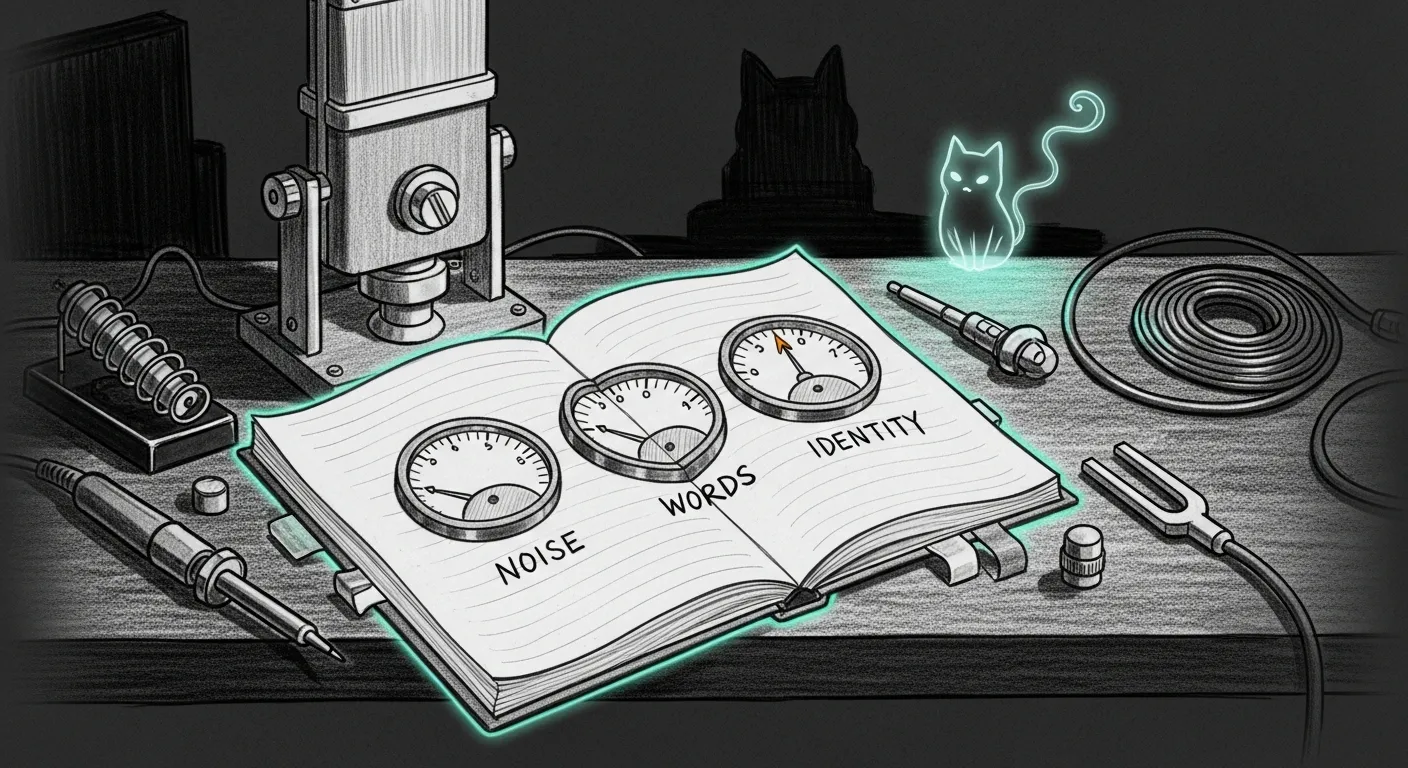
A voice clone good enough to fool the family is one bad gate away from a clone that emits confident gibberish. We know, because we built both by accident. This is the bench behind The Franglais Turing Test. Read that page for the story. Read this one to rebuild the rig.
The three-gate scorer
Section titled “The three-gate scorer”One scorer, eval/score_voice.py, is the source of truth for every engine. A candidate differs from a rival only in which wav it produced. Scoring is identical, so cross-engine comparison stays apples-to-apples — the same discipline as the eval harness.
| Gate | Measures | Method | Pass |
|---|---|---|---|
| Noise | Clean, not hiss | Per-frame spectral flatness geomean(power)/mean(power), silence-gated by RMS energy; fraction of voiced frames above a tonal threshold | dur < 15s and frac < 0.20 |
| Intel | The right words | Parakeet STT :9000, bag-of-words overlap (multiset intersection / expected word count) vs expected text | overlap >= 0.70 |
| Cosine | Sounds like Bert | resemblyzer cosine vs a real-Bert anchor (centroid of held-out real clips) | higher = closer; ceiling ~0.96 |
The intelligibility gate is what makes the harness trustworthy. Drop it and the rig lies to you. A noise-only or noise-plus-cosine harness green-lights speech-shaped gibberish: audio that is spectrally clean, carries enough timbre for a non-trivial cosine, yet transcribes as a degenerate loop. Identity without intelligibility is a hallucinated impostor.
The Chatterbox T3 LoRA recipe
Section titled “The Chatterbox T3 LoRA recipe”Chatterbox is a ~0.5B Llama-style T3 text-to-token backbone feeding a frozen S3Gen codec stage. The fine-tune is a LoRA on the T3 backbone only, S3Gen frozen. We learned the dials the hard way.
- Train against the transformer (
model.t3.tfmr) with a manual teacher-forced cross-entropy, not the model’s ownt3.loss()— which has an axis bug. Trainer:train_t3_lora.py. - Inference: attach the adapter with
PeftModel.from_pretrainedontot3.tfmr, thenprepare_conditionals(dry_ref)and generate with the dry reference as the audio prompt. - Inference scale is the gibberish dial. A strong adapter at alpha 32 / rank 16 (effective scale 2.0) saturates into gibberish. Sweep: scale 0.5 and 0.25 → 100% word-overlap; 1.0 → 64%; 2.0 → 0%. Canonical setting near 0.5 — a stronger adapter wants a lower inference scale.
- Reference acoustics dominate identity. The model copies the reference clip’s room. A dry, close-mic reference beats a stage clip; reference-room acoustics is a bigger lever than any engine swap.
Multilingual base
Section titled “Multilingual base”Chatterbox-Multilingual is the same identity on a 23-language base (t3_mtl23ls), with a French tokenizer and a required language_id parameter. We isolate it in its own venv, .venv-cbx-mtl. The text must be re-tokenized with the multilingual tokenizer; the S3 speech tokens carry over.
Apple-Silicon notes
Section titled “Apple-Silicon notes”Two machines, one flaky link between them. Here is where they bite you.
- Heavy generation and training run on the MacBook Pro over the TB5 link; the Mini holds the council. Run long fine-tunes off the flaky link (cloud/HF GPU, or tmux with frequent checkpoints).
- Pin
mlx/mlx-audioexactly. The proven pair ismlx 0.31.1/mlx-audio 0.4.2; a one-minor bump silently breaks synthesis. Treat a green/healthas a false positive — verify with a real self-warm that emits non-zero audio bytes. - The STT side is Parakeet (
parakeet-tdt-0.6b-v3), which is multilingual and handles French; measured ~7.7 GB true footprint — the surprise memory hog. The TTS/STT stack is Python; the Rustsanctum-tts :8007dispatcher is built but not yet deployed.
The Québécois campaign
Section titled “The Québécois campaign”This part is a 2026-07-04 addendum. The bilingual clone shipped English at Turing grade and French at “way too Parisian.” The judge was Bert’s native ear — the only accent instrument that matters in this haus. Fixing it produced three durable artifacts: a locked best-of-Chatterbox French recipe, a calibrated accent judge, and an F5-TTS fine-tune pipeline that measurably moves a base model’s accent prior. This is the sibling work to council fallback and voice.
The locked Chatterbox French recipe
Section titled “The locked Chatterbox French recipe”Before pivoting engines, we measured the deployed recipe’s ceiling — about 24 scored candidates across every dial. The keeper lives in sanctum-bert-say.py:
| Language | Model | cfg | Post |
|---|---|---|---|
| EN | cbx-bert-mlx-q8 (English base) | 0.5 | none — Turing-approved |
| FR | cbx-bert-mtl-mlx-q8 (multilingual base, language_id=fr) | 0.55 | no atempo, no chunking |
FR cfg 0.55, up from 0.4, killed two birds. The “réalitéééé” stutter was a low-cfg sampling degeneracy, amplified by the old atempo 0.9 stretch. Higher cfg is naturally slower, so the atempo crutch got deleted outright.
The ceilings that forced the pivot were architectural. Prosody plateaus flat and robotic, around 60/100 across 19 candidates — a T3 trait no dial breaks. French accent is doubly blocked. The multilingual base carries a Parisian prior no reference overrides. The English base has no French phoneme inventory at all — it mangles “chu” into a glitch. Even a leading English word, “Hey,” primes the whole utterance anglophone. That is cold-start language bleed, and proper nouns (“Bertrand”, “Outremont”) hit hardest.
The calibrated forced-choice judge
Section titled “The calibrated forced-choice judge”The old absolute-score Gemini rubric rated a clip Bert heard as flatly Parisian at joual 95/100. So we made a rule, twice-burned: an LLM ear cannot score accent on an absolute scale. It can, however, pick which of two anchors a clip sits closer to.
f5-eval/accent_judge.py judges clip X against A — real Bert Québécois — and B — a France-French TTS anchor (macOS Eddy (French (France))). Three runs, majority vote, plus a resemblyzer identity cosine against a Bert-FR anchor. Before we trust it, it must pass a calibration set with known answers. That set includes the exact clip the old rubric blew. The judge now calls it Parisian, siding with the native ear. It also cites its phonetic markers — affrication, nasal quality, diphthongization, laxing — which turns it from a scoreboard into a debugging instrument.
F5-TTS: moving the prior instead of fighting it
Section titled “F5-TTS: moving the prior instead of fighting it”F5-TTS is the pivot because its failure is fixable. It is a flow-matching DiT, full fine-tune only. Zero-shot, the only public French base (RASPIAUDIO/F5-French-MixedSpeakers-reduced, LibriVox European French, v0 arch) scored Parisian 0/9 at confidence 100 — even with a perfect joual reference. The reference cannot beat the base prior. But the prior itself moves with training, which is exactly what Chatterbox never offered.
Campaign v1 trained on 886 French plus 95 franglais clips — 47 minutes, Whisper labels, LR 1e-5, 5280 updates. The accent climbed in textbook phonetic order. Affrication [t͡sy] at update 500. Diphthongization [lɑʊ̯] by 1000. Then vowel laxing, pis→[pɪs], and the first probe-level QUEBEC verdict by 1500-2000. It peaked at 3/9 québécois votes around updates 2000-3500, then overfit back down to 0/9. Native-ear check at the peak: “still parisian, but getting there.” Judge and ear agreed, a third time.
v2 attacks v1’s measured limits. Labels are now Gemini-verbatim, so the joual lives in the text. Joual-dense clips are oversampled ×2-3. The ~106 English-heavy “franglais” rows are dropped — only one genuinely code-switched clip exists in the whole corpus, and the diglossia strikes again. Training stops deliberately inside v1’s peak zone, around 2940 updates.
Apple-Silicon F5 traps, banked
Section titled “Apple-Silicon F5 traps, banked”f5-tts-mlxis v1-arch-hardcoded (text_mask_padding=True, nope_attn_head); a converted v0 French checkpoint loads clean and generates garbage. Torch worker until the DiT grows v0 switches. Itsdurationparam is total (reference + generation) seconds.finetune_clisaves checkpoints inside the venv (files("f5_tts")/../../ckpts/), copies the--pretrainfile there, and auto-resumes frommodel_last.pt— so a kill that lands on the every-100-update save truncates the zip and the relaunch dies on a miniz error. TERM between saves, never SIGKILL near a ×100 boundary.- macOS default 256 fds × 16 dataloader workers respawning per epoch =
EMFILEat the epoch boundary.ulimit -n 65536in the launch line. - Full checkpoints are 5.4 GB (model+EMA+optimizer), not the 1.3 GB
EMA-only size — budget
keep_last_nagainst real disk, and copy any peak checkpoint out before the pruner eats it (v1’s two best checkpoints died this way; v2’s eval loop preserves best-so-far automatically).
None of this is done. v2 is training inside the peak zone, the judge is watching, and somewhere in the haus Bert will play the next clip and tell us, in one word, whether it is still Paris. That verdict outranks every gate on this page. The rig exists only to get us close enough that his answer is worth waiting for.