

The twin that would not die
It started as a cost question. LM Studio was gone, so why does the Mini
still run a container engine at all? The ledger said one tenant mattered
— the Home Assistant docker twin. The plan was small: an afternoon
inventory and a quiet docker stop.
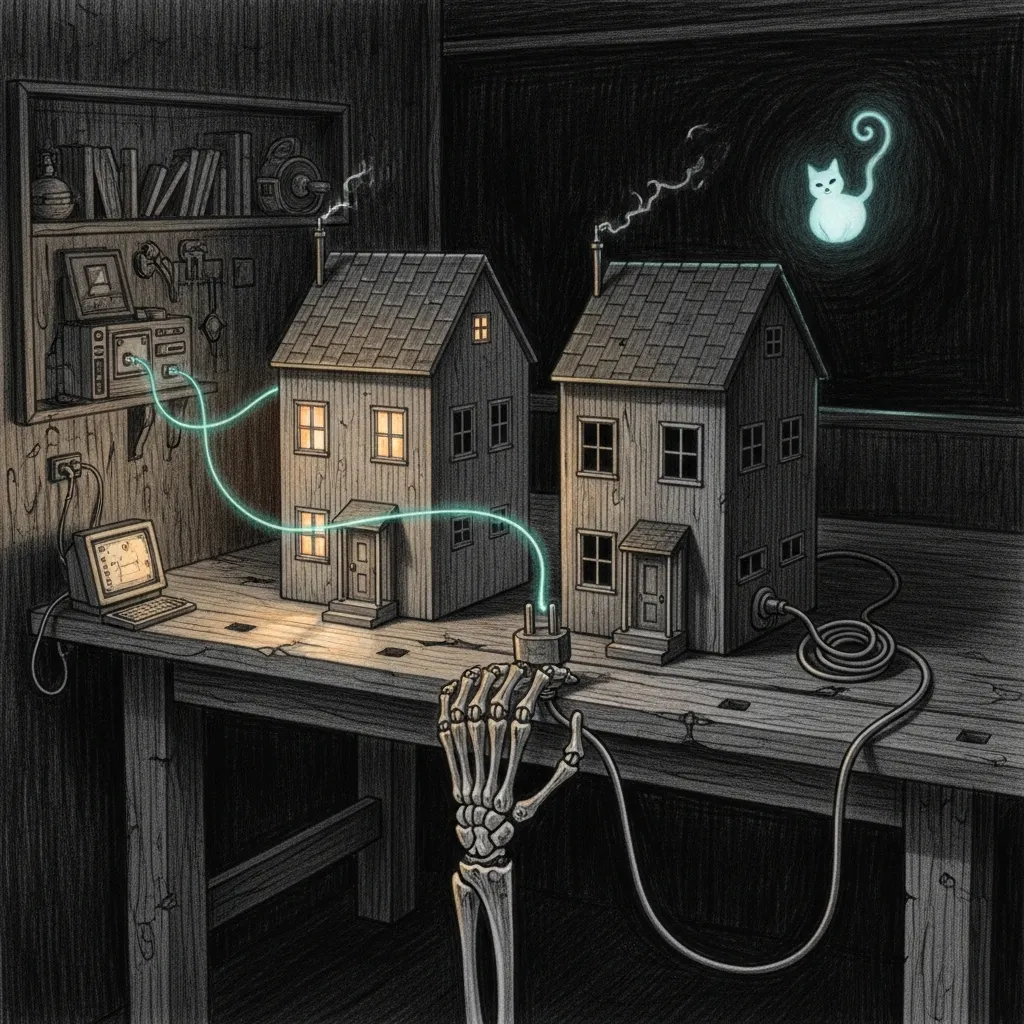
The inventory found something else. A second brain had been running the haus in parallel for months, firing the same automations as the real appliance, and it would not stay dead.
The clone nobody meant to keep
Section titled “The clone nobody meant to keep”The twin was supposed to be a sanctum sidecar: briefings, Force Flow
polling, a config mirror of the real Home Assistant appliance (the Green,
10.0.0.3). The recorder database told a different story. Every one of
its thirty-odd automations was live, and the scheduled ones fired in
lockstep with the Green’s identical copies: sunset warm-up at 21:09 on
both brains, climate setpoints at 06:00 on both, bonne-nuit at 23:00 on
both, and the Qui-Gon resilience test at 04:00 — twice a morning, every
morning. The twin’s hourly auto-healer had fired forty-five times in two
days, faithfully reloading its own zombie cloud-Tuya integrations,
because the localtuya migration
had only ever happened on the Green.
The split-brain had a shape. Device actions worked from both instances;
anything touching a Mini loopback service worked only from the twin,
because Fort Knox binds Force Flow (:4077)
and sonos-bridge (:1969) to 127.0.0.1. The Green’s copies of those
automations had been failing silently since the split — including the
family’s homework-mode toggle and every
screen-time dashboard sensor. The twin, meanwhile, was the only
thing keeping the Windu security reports alive. And one grim bonus: the
Force Flow failsafe’s P0 fallback pushed to the twin’s mobile_app
notify service. The phones moved to the Green long ago. The escape hatch
had been welded shut for months and nobody heard it.
The cut
Section titled “The cut”The jobs that mattered became launchd agents. windu-ha-report.py reads
live entity states from the Green and posts to Force Flow —
com.sanctum.windu-perimeter-check at 23:00 and
com.sanctum.windu-daily-digest at 03:00, both live-tested. The 04:00
resilience test became com.sanctum.resilience-test, calling the same
ssh wrapper into the VM — and now runs once a morning instead of twice.
Every consumer repointed to the Green: ha-gateway.js (the VM agents’
proxy), sanctum-endpoints, the doctor and status probes, and the
failsafe fallback, which now pushes to phones that exist. The service
registry entry lost its remediation actions so nothing would helpfully
resurrect the corpse.
Then docker update --restart=no, docker stop, and the twin was down.
The resurrection
Section titled “The resurrection”Twenty-five seconds later it was healthy again.
The tell was in the Force Flow access log: a HomeAssistant/2026.4.4
user agent still polling every thirty seconds after the stop. The restart
policy had survived, which acquitted docker itself; a second stop-and-watch
acquitted the castellan watchdog. The fingerprint that convicted was
arithmetic: the resurrection landed at 21:14:55, and a launchd agent with
StartInterval 1800 loaded at the 18:14 boot ticks at exactly :14:55 and
:44:55. That agent was ha-self-healer, whose heal script runs
docker start homeassistant when the container is down. Its own log
closed the case: container not running — restarting (closed-loop
verify). container verified up.
The twin, it turned out, had four independent guardians: the docker
restart policy, the castellan service-registry remediation, ha-self-healer
on its half-hour tick, and service-doctor’s --fix mode. Decommissioning
a service means finding every hand that can reach the defibrillator.
The healer is booted out and its plist renamed; the next tick came and
went with the twin still cold.
The bridge
Section titled “The bridge”What the twin uniquely provided was reach: it sat on the Mini’s host
network, so Green-side intent could become Mini-side action. Its
replacement is ha-green-bridge.py (com.sanctum.ha-green-bridge), a
single outbound websocket from the Mini to the Green. No new listening
ports, nothing exposed — the Green never calls in; the bridge reaches out.
Three flows ride it. The homework toggle on the family dashboard now
actually starts and stops homework mode in Force Flow — verified live,
both directions, about seven seconds end to end. When homework expires in
Force Flow, the bridge flips the Green’s toggle back off. And if Alarmo
ever enters triggered, Force Flow gets a critical notification — the
sirens and whole-house TTS were never broken, since that response is
Home Assistant-native and runs on the Green itself.
The dashboard sensors took one registry trick. The Green’s screen-time
package defines rest: sensors that poll its own loopback — permanently
unavailable, and their entity ids were squatted by the dead platform. The
websocket API renamed them to *_rest_dead and disabled them, freeing
the ids; the bridge now pushes real state into them every minute. The
proof was the Green’s own template sensors computing again: curfew
23:00, countdown 1h12, schedule type conge — July, no school.
What remains
Section titled “What remains”One Home Assistant. The Mini’s container engine now hosts Outline and the
conduit, nothing else. The twin’s config stays on disk at
~/.openclaw/homeassistant/ — two gigabytes of history and its own
nightly backups — until a deliberate decision deletes it. Six automations
whose actions could never work on the Green sleep with automation.turn_off.
And the colima question that started all this answered itself from the
incident archive: the old runtime’s daemon died three times in one April
day, which is why OrbStack holds the socket today.
The haus has one brain again. The other one is allowed to rest.