

2026-07-03: Verify Before You Fortify
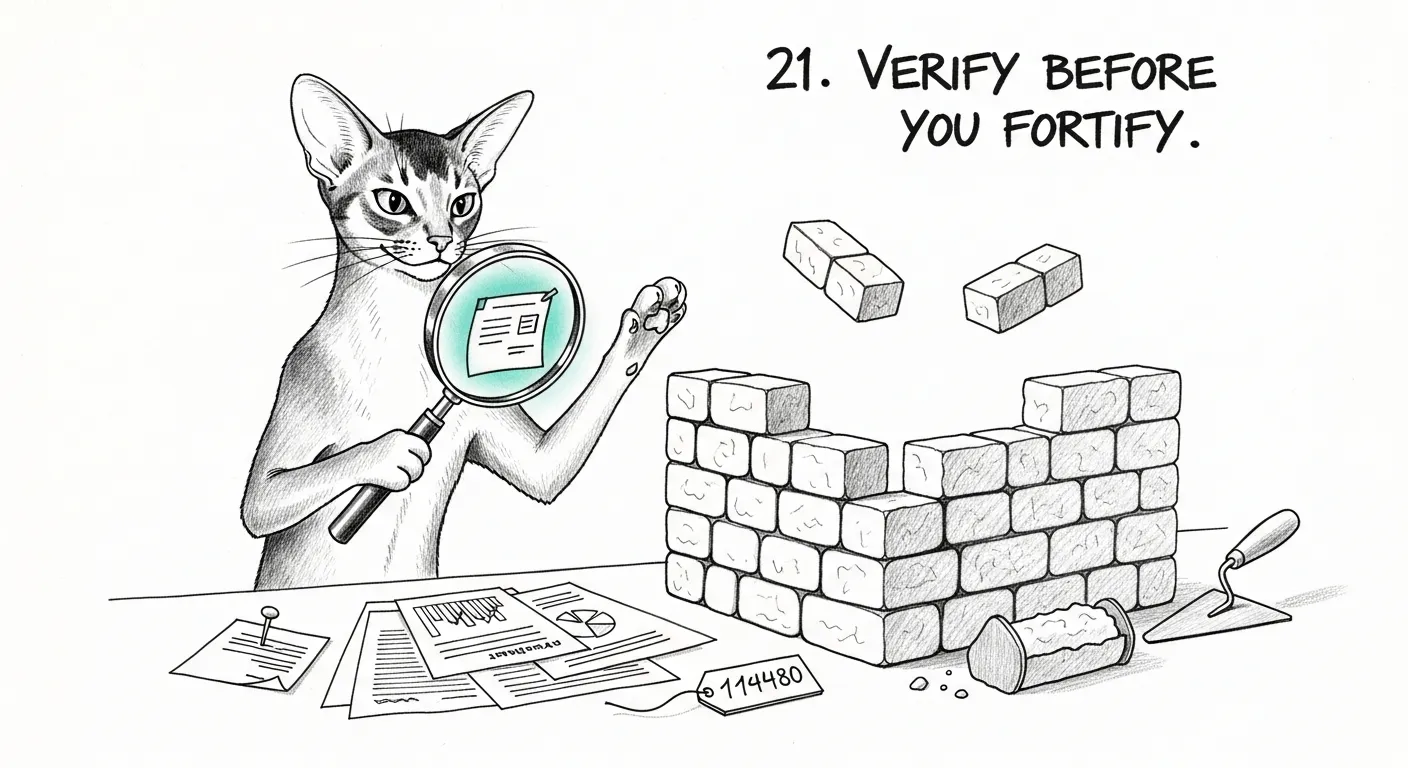
“Give me the full haus security status, and fix what’s weak.” That was the whole request. By the time the sweep finished, six fixes sat staged and ready to ship. Every one of them was wrong.
Not carelessly wrong — each was a plausible conclusion drawn from a real signal, the kind Windu, the council’s security seat, would page a human about at 3 AM without a second thought. Wrong in the expensive way: the most dangerous move in security work isn’t missing a threat, it’s fortifying the wrong thing with confidence. The only thing between these six and a shipped mistake was the habit of reading the box before rebuilding it.
The firewall that was “749 days out of date”
Section titled “The firewall that was “749 days out of date””A freshly-deployed sentinel reported the Firewalla’s firmware as 749 days old and paged for an
update. The obvious move: automate the firmware update. Instead we read the box: /etc/firewalla_release
says 0.0614 — but that’s the immutable base OS image from 2024, which never changes. The actual
product was on v1.965, auto-updated fifteen days prior, via a native cron that runs every night
at 03:00. The box was never behind. The sentinel had been reading the one version string guaranteed to
look ancient.
The bridge that had been dead for two days
Section titled “The bridge that had been dead for two days”The screen-time control bridge returned 503, and its error blamed DNS: getaddrinfo ENOTFOUND firewalla.encipher.io. The tempting story: a DNS-floor rule blocking the cloud endpoint. But the
Mini’s own resolver answered that name instantly. Diff the working twin — the OS resolves it, the
bridge’s process doesn’t. The bridge process had started before the network recovered days earlier,
detached from its launchd job, and was carrying a dead resolver like a ghost. Not a DNS bug. A stale
process. Kill the orphan, bootstrap fresh — sdkReady in five seconds.
Post-quantum crypto verified where the attacker isn’t
Section titled “Post-quantum crypto verified where the attacker isn’t”The council traffic was already protected with post-quantum key exchange (X25519MLKEM768) — the one
genuine harvest-now-decrypt-later target. The status tool proudly reported it green. Then we looked at
what it probed: 127.0.0.1. Loopback. The one interface an eavesdropper can never reach. The council
also binds on the tailnet and VM networks — where an attacker actually is — and those were
unverified. They turned out to be PQ too, but “we assumed” is not “we proved.” We extended the
check to the network-exposed hops and added a daily sentinel that pages if any of them ever regress to
classical crypto. Deploying isn’t the milestone; verifying where it counts is — the same lesson
the post-quantum vault had to learn the hard way.
The isolation that would have broken the lights
Section titled “The isolation that would have broken the lights”The plan to segment IoT devices onto their own isolated group was sound on paper — until we traced it against last night’s work. Those ~50 bulbs had just been migrated off the Tuya cloud to local control, driven by Home Assistant over the LAN — last night’s work, still warm. Firewalla’s flat-network isolation is a bidirectional block with no trusted-initiated exception. Isolating the bulbs would have severed Home Assistant from them — breaking the local control we’d built to close the cloud risk in the first place. And the cloud risk was already gone. We didn’t do it.
The alarm list nobody could read
Section titled “The alarm list nobody could read”876 active firewall alarms. Ninety-six percent were benign kids-activity notices — game, video, new-device — piled up over 26 days, burying the ~19 that mattered. We archived the aged benign classes through the box’s own supported path (and confirmed it stuck — alarms are events, not regenerated state), never touching a single security-class alarm, and left the alarm generation alone so the parental notices still fire. A daily job keeps the list from re-drowning.
The watchers had no watcher
Section titled “The watchers had no watcher”The last question was the sharpest: is everything self-healing? The honest audit said: the auto-fixable things heal, the judgment-required things alert a human (correctly — you do not auto-remediate a crypto regression or a secrets mismatch), and the alert pipe reaches the phone. But nothing ensured the monitors themselves stayed loaded. A sentinel unloaded mid-life would stay dead until a reboot. So we built the watcher-of-watchers — a keeper that re-loads any dropped critical monitor every ten minutes, the seed of what later grew into the fleet that watches itself.
The through-line
Section titled “The through-line”Six fixes, six wrong first conclusions: automate an update that was already running, blame DNS for a stale process, trust a green check on the wrong interface, isolate devices into breakage, alarm on the base-image date, assume the monitors monitor themselves. None of them shipped, because each was checked against reality before it was fortified. The haus is measurably stronger tonight — single-NAT, key-only SSH, PQ verified where it counts, monitors that watch each other. But the durable win isn’t any one control. It’s the order of operations: evidence before attribution, verification before fortification. The boring config layer is always cheaper to read than the exotic theory is to chase.
Tommy, who patrolled these grounds for fifteen years and never once caught a mouse he hadn’t first watched for an hour, would have understood the whole day in a glance. You do not pounce at the noise. You pounce at the thing that made it.