

2026-07-29: The Alarm Nobody Could Answer
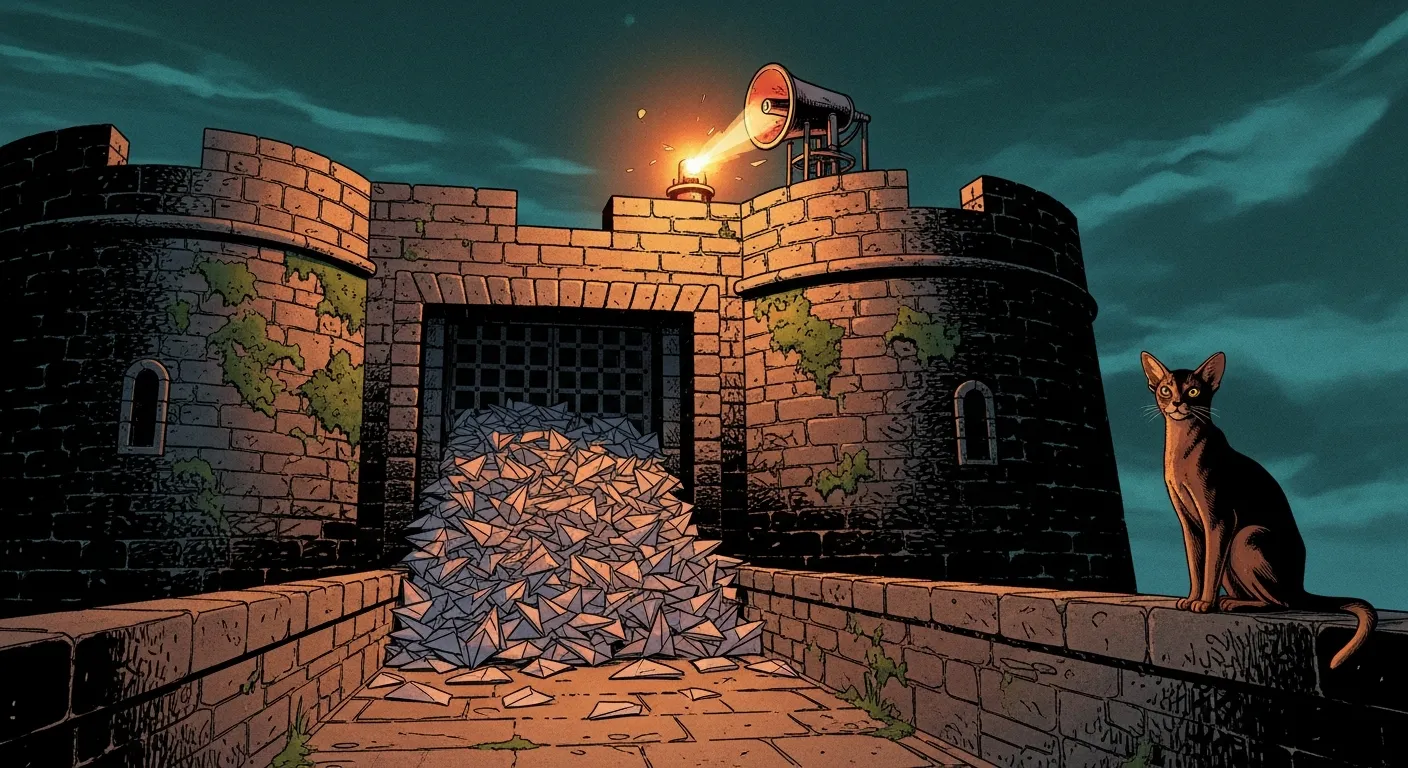
At 08:56 on a Wednesday morning the haus worked out that it had no internet, and told somebody.
It told somebody again at 10:01. In between it wrote the verdict into a JSON file, three anchors down, gateway up, and went back to sleep for sixty seconds. It had been doing this, faithfully, three thousand nine hundred and fifty times. The alarm was perfect. Nobody was coming.
The only witness unsurprised by any of it was Tommy, the haus’s late Abyssinian, watching from the parapet the way he always has. A force-ghost expects nothing of the living infrastructure, and so is never let down by it. The rest of us had not yet learned the lesson he was born knowing.
This is a field note about the difference between a smoke detector and a fire brigade, and about the twelve hours we spent learning that we had only ever built one of them.
The evening it changed its name
Section titled “The evening it changed its name”It started the night before, and it started politely. An episode finished on the headset, the operator picked up an iPad to read the tech news, and the videos would not load. Mail arrived. Text arrived. Video sat there. A VPN was tried, on the reasonable theory that something upstream was being unpleasant, and the VPN did not help either. Downstairs, an agent was asked to look at the network and reported that the network was fine.
The network was fine. That was the honest answer to the question asked.
What had actually happened was that at 22:31:29, after Connect time 8396.3 minutes — five days and twenty hours of unbroken service — the uplink session dropped, and thirteen seconds later came back up under a different public address. The haus changed its name in the middle of the evening. Every connection that had been established under the old name died with it. Everything opened fresh afterwards worked, which is precisely why mail looked healthy and a video stream did not.
Whether that alone accounts for ninety minutes of dead video, the logs do not say, and this note is not going to pretend otherwise. What matters is what happened next, because what happened next was our own fault.
The cure
Section titled “The cure”Faced with a network that was misbehaving in a way nothing could explain, the operator did the correct and universally recommended thing. He rebooted the modem, the firewall and the mesh access point.
That reboot is what took the haus down for twelve hours.
On the way back up, the firewall’s Redis lost a single background save to a boot-ordering race — the temp snapshot went to rename itself into a data directory that was not ready yet. One failed save, immediately recovered. But Redis ships with stop-writes-on-bgsave-error set to yes, so that one failure froze every write behind a MISCONF error, and it froze them during the exact ninety seconds in which FireMain was trying to initialise.
FireMain has a retry loop for this. It ran six times, five seconds apart, and it would have won — except that Redis restarted underneath it, the in-flight command aborted, the rejection escaped a recursion that was never awaited, and the loop simply stopped existing. No crash. No exit. systemctl reported active (running) for the next twelve hours, which was true and completely useless.
What FireMain had not finished doing was building the firewall. The FORWARD chain defaults to DROP by design; the rules that let your traffic through live in the layer that never got built. So the router came up healthy, confident, and silently ate every packet the haus tried to send.
Why it looked like the internet’s fault
Section titled “Why it looked like the internet’s fault”Because DNS kept working. dnsmasq answers on the INPUT path, and INPUT was fine — so every device could still look up an address perfectly, and then reach nothing at it. The box itself could fetch from the internet, because its own traffic is OUTPUT, not FORWARD. Public status pages for the video service said all clear, correctly.
Every signal available from inside the haus pointed at the internet. The call was coming from inside the haus.
What broke it open was a controlled A/B that took thirty seconds: a laptop on a phone hotspot reached the CDN with a TLS handshake in under a third of a second, while the server on the haus network timed out against the same hostnames. Same targets, one variable. After that it was one command — FORWARD sitting at policy DROP with 1.9 million packets and 219 MB counted against it, and none of the jumps that should have been there.
The repair was the vendor’s own idempotent setup script, install_iptables_setup.sh, which rebuilt in seconds what six minutes of restarts had not: 17 filter chains to 98, 15 ipsets to 504, packet loss 100 percent to zero.
The part that stings
Section titled “The part that stings”We had the alarm. sanctum-wan-sentinel classified the outage correctly — anchors unreachable, gateway reachable, therefore the uplink and not the LAN — and paged four minutes after the failure. It was right, it was fast, and it was ignorable, because the only action it was ever armed to take was to re-point the council’s models at local hardware. That is a sensible thing to do when the cloud is gone. It does nothing whatsoever for a haus with no internet.
The first fix drafted for this incident was a second detector on a two-minute tick. It would have watched the same path, reached the same verdict, and been equally unable to act. It was deleted before it saw a second morning.
Detection was never the gap. Agency was.
The sentinel now carries a hand: a bounded repair ladder it can run itself, armed separately from its other powers because they answer different questions. It still refuses to touch anything when the fault is local to the machine doing the asking, and it still never reboots the box — that judgment stays with a human. Its hourly sibling gained the one check nobody had thought to write, which is whether the sentinel is still ticking at all. A dead watcher and a quiet one look exactly the same from the outside, and we would rather not find out which one we have at 22:31 on a Tuesday.
The bug itself went upstream to the vendor the same day. It is a good bug, and it deserves a fix better than ours.