

2026-04-20: The Pressure Valve Trilogy
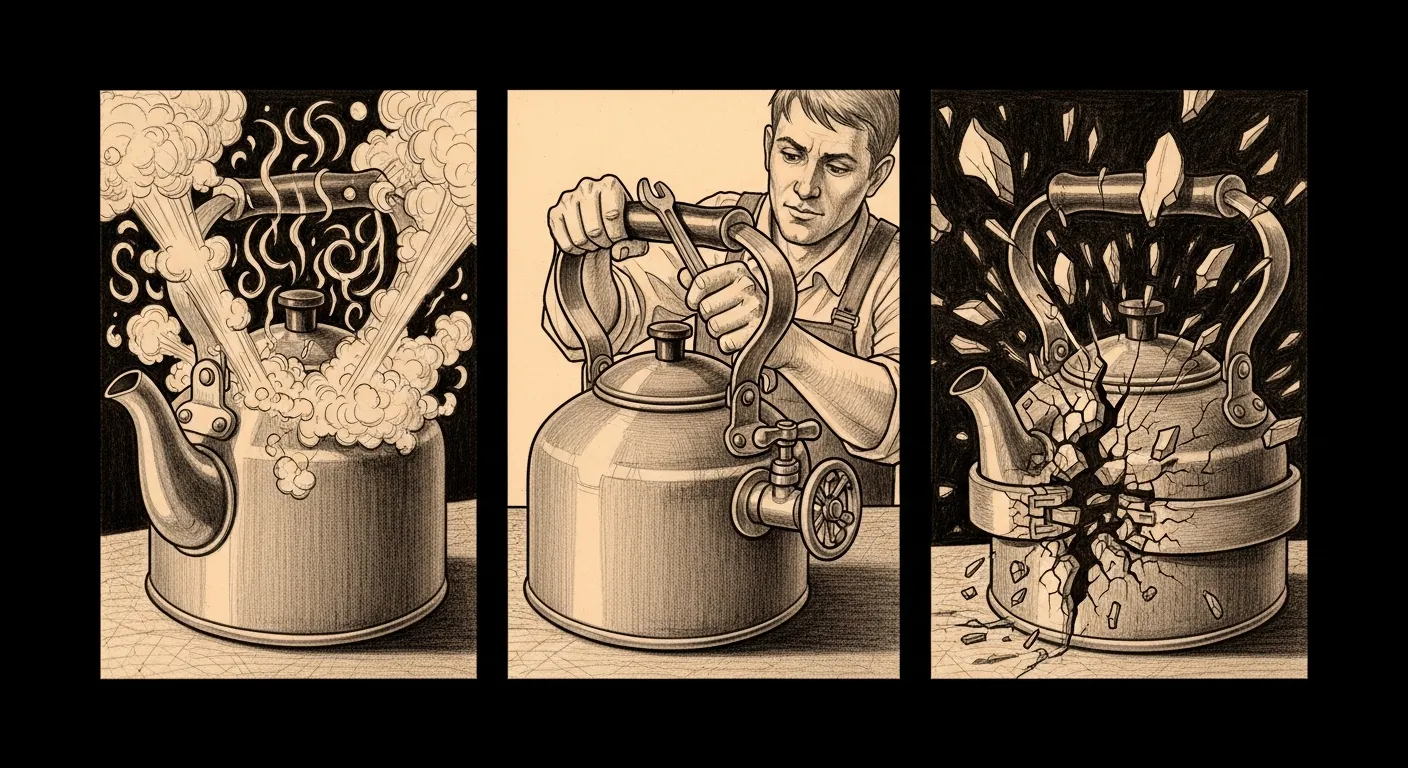
One day, three acts. At midnight the Mini panicked. By lunch we had shipped a Rust daemon to make sure it never happened again. By dinner that same daemon had, within five minutes of going live, killed the exact service it existed to protect — twice — while the actual memory hog sat untouched a few gigabytes away. This is that day, told in order, because the mistake teaches more than the fix, and the fix teaches more than the original design.
Midnight — the reboot was a panic
Section titled “Midnight — the reboot was a panic”Earlier in the day we had shrugged at the midnight reboot: macOS applied an update, or the kernel panicked, or gravity hiccuped. It was gravity’s alibi that failed. /Library/Logs/DiagnosticReports/Retired/panic-full-2026-04-19-235812.0002.panic is a 3.4 MB receipt for an AppleARMWatchdogTimer kernel panic — watchdog timeout: no checkins from watchdogd in 90 seconds — fired at 23:58:12 EDT on the Mini.
The JetsamEvent thirteen minutes after reboot tells the story better than the panic log. At kill time, a 64 GB machine was carrying this:
| Process | RSS |
|---|---|
sanctum-mlx (pid 9221) | 65,813 MB |
talagentd (Apple Intelligence agent, macOS 26, idle) | over 7 GB |
| QEMU Ubuntu VM | 4.5 GB |
com.apple.Virtualization.VirtualMachine | 1.9 GB |
four leaked metal shader-compilers (a forgotten cargo build) | ~770 MB each |
The metal processes were collateral from the council-integrity build earlier that evening, four of them pinned at 100% CPU. The compressor hit 100% of its segment limit, sixty-nine swapfiles deep. watchdogd could not get scheduled for 90 seconds because every thread was blocked on a page fault. The kernel watchdog fired. The boot was a recovery, not a maintenance window.
The 148,181-error forensic analysis that produced the living-force manifests had already named this: memory-pressure cascade, Pattern 011, with memory_pressure_tier2 and memory_pressure_tier3 shed lists enumerated in sanctum-cascade-prevention.yaml. Line 985 declared the pattern dependent_on: ["service-graph.py", "watchdog", "system-memory-monitor"]. Of those three, exactly two existed. The system-memory-monitor was YAML. Nothing enforced it, and the kernel does not read intentions.
Lunch — a valve, shipped
Section titled “Lunch — a valve, shipped”The fix was sanctum-pressure-valve: a 2.2 MB Rust binary, 14 unit tests and 3 integration tests, one LaunchAgent, living at services/sanctum-pressure-valve/ in the sanctum-rs workspace. It polls vm_stat and sysctl -n vm.swapusage on a 5-second tick and classifies pressure against thresholds tuned to the M4 Pro. Promotion requires two consecutive confirming samples; recovery is immediate.
| Level | Threshold (worst of) | Action |
|---|---|---|
| green | healthy | none |
| yellow | 8 GB available or 70% swap | shed one tier-3 agent (kiwix-serve, reranker, xtts-server) |
| orange | 4 GB available or 85% swap | shed tier-2 (memory-vault, qwen3-tts, mdns-docs); SIGSTOP any allowlisted hog over 10 GB RSS |
| red | 2 GB available or 95% swap | SIGKILL the largest allowlisted RSS consumer |
The allowlist is tight and explicit; the denylist is hard-coded and not overridable by environment.
| List | Members |
|---|---|
| Allowlist | sanctum-mlx, qemu-system-aarch64, com.apple.Virtualization.VirtualMachine, LM Studio Helper, metal (only matched with -x metal), Docker’s VZ shim, ollama-runner |
| Denylist | launchd, WindowServer, watchdogd, kernel_task, sshd, tailscaled, and the valve itself |
A heartbeat at ~/.openclaw/state/sanctum-pressure-valve.json is atomic-renamed every tick with the current Snapshot, machine_level, last_action, pid, and binary version — so sanctum-watchdog can mtime it to catch a wedged valve the way it catches zombie listeners.
plist: ~/Library/LaunchAgents/com.sanctum.pressure-valve.plistbinary: /Users/neo/Projects/sanctum-rs/target/release/sanctum-pressure-valve (2,276,192 bytes)logs: ~/.openclaw/logs/sanctum-pressure-valve.{log,err}state: ~/.openclaw/state/sanctum-pressure-valve.jsonalerts: ~/.sanctum/alerts.json (appended, source="sanctum-pressure-valve")It came online at 2026-04-20 15:03:23 UTC, classified orange at 15:03:28 (5 s to promote, debounce working as designed), and fired its first action the same tick — launchctl bootout gui/501/com.sanctum.memory-vault. Swap dropped from 90% to 88% by the next tick. The manifest had finally grown teeth.
The corollary
Section titled “The corollary”launchctl list is not proof of a running service. The second column is a last-exit-status. A row whose first column is - and whose second is 1 is a service that tried to start and failed — in this case 3,671 times since midnight — while the dashboard cheerfully reports it “configured” because the plist sits in ~/Library/LaunchAgents/. The health surface of a service is the heartbeat it writes, not the plist that claims it should be writing one.
Dinner — the valve killed what it guarded
Section titled “Dinner — the valve killed what it guarded”We shipped at 15:03 and watched for five minutes. In those five minutes the valve SIGKILL’d sanctum-mlx twice — pid 788 at 10.9 GB, pid 2861 at 9.0 GB — during the process’s legitimate 27B-4bit model-load burst, which transiently needs about 14 GB of RSS before settling at 18 GB steady-state. Launchd respawned it both times. The valve killed it again. Meanwhile the actual top-RSS hog — an LM Studio node shim at /Users/neo/.lmstudio/.internal/utils/node, 8.6 GB — went untouched, because the v0.1.0 allowlist searched for the literal substring LM Studio and the shim’s path does not contain it.
A safety daemon that kills the service it protects while ignoring the real offender has read the wrong page of the manual.
The right move was not to iterate alone. The sanctum council was the correct reviewer — but the gateway on the VM was unreachable, the VM itself having been a casualty of the valve’s earlier qemu-system-aarch64 kill, and the local openclaw agent --agent main calls against Opus returned abandoned sessions or blank responses. The reasoning infrastructure had been starved by the exact pressure we were trying to solve. That is the best data point in the entry: a pressure-relief system whose first act kills the oracle that diagnoses pressure has re-invented deadlock. Review fell to an external-context subagent as stand-in. It returned five corrections in 30 seconds. All five shipped in sanctum-rs 920c0eb.
The five corrections
Section titled “The five corrections”| # | Fix | Mechanism |
|---|---|---|
| 1 | The kernel is the authoritative signal | Read kern.memorystatus_vm_pressure_level — NORMAL (1), WARN (2), URGENT (3), CRITICAL (4), the same enum Jetsam consults — every tick; final level is max(kernel_level, threshold_level). Lesson from systemd-oomd: the kernel already knows, don’t reimplement it out of vm_stat. |
| 2 | Compressor growth is the leak signature | 30-second rolling window over Pages occupied by compressor; at ORANGE, escalate to RED when growth exceeds 100 MB/s. Load-bursts show near-zero growth (clean, pre-faulted pages); paired with per-process RSS floors, never trusted alone. |
| 3 | Per-entry policy, not a flat allowlist | sanctum-mlx and the LM Studio processes are now SigstopOnly (reversible freeze), never SIGKILL. QEMU and Apple Virtualization VMs stay KillAllowed with an 8 GB kill floor — they allocate at boot and stay flat, so runaway growth there is always a leak. |
| 4 | Regex matching, not substring | The regex crate (already compiled via tracing-subscriber’s env-filter feature — zero marginal build cost); patterns r"\.lmstudio/" and r"/metal(?: |$).*?-x metal". The metal pattern excludes the MTLCompilerService GPU runtime. earlyoom learned this in 2018. |
| 5 | Cooldown 60 → 120 s | 60 s could still stack three actions in a 15-second window against launchd’s respawn timing. 120 s gives the system a full breath between moves. |
Dry-run as the default for the first hour
Section titled “Dry-run as the default for the first hour”Phase 2 deploys with PRESSURE_VALVE_DRY_RUN=1 set in the plist. Every planned action logs to ~/.openclaw/logs/sanctum-pressure-valve.log with dry_run=true and executes nothing. The first tick after redeploy — 02:37 UTC, machine in severe pressure (swap 100%, kernel=CRITICAL, compressor growing at 850 MB/s) — planned a SIGSTOP on pid 45013 at 8.6 GB in /Users/neo/.lmstudio/. Exactly the process v0.1.0 could not see. The SIGSTOP was a dry-run; the log was real. After six hours of clean observation with zero false-positive kills, the DRY_RUN line comes out and the valve goes live. If any planned action looks wrong, the patch cycle runs again before the switch is flipped.
What the day was actually teaching
Section titled “What the day was actually teaching”Three rules survive it. The kernel, not your derived metric, is the authority — kern.memorystatus_vm_pressure_level is one sysctl away and it does not lie. SIGKILL is for leaks, SIGSTOP is for load-bursts, launchctl bootout is for evictions; these three verbs are not interchangeable, and the per-entry Policy field now encodes the choice at the config layer rather than the action layer. SIGKILL a service on a live listener and you orphan every socket, child proc, and in-flight request — for sanctum-mlx that means council integrity goes red and the off-box canary across Tailscale starts logging 502s. And if your oracle lives on the resource you are conserving, you have built a deadlock: the braces must live outside the belt, which is why the next crisis needs a cached off-machine advisor that stays reachable when the local reasoner is itself the victim.
The valve now runs on manoir at pid 46053, v0.1.0 phase 2, sanctum-rs 011252d (phase 1) plus 920c0eb (phase 2), pushed to origin and mbp — dry-run until roughly 08:37 UTC on 2026-04-21, cooldown 120 s, debounce 2 ticks, 27 lib + 2 main + 3 integration tests green, up from 19. The heartbeat now refreshes every 5 s with the kernel pressure enum and the compressor growth rate alongside the prior fields. Four follow-ups stay open: flip DRY_RUN=0 after the window; leave launchctl bootout sanctum-mlx a human decision rather than auto-escalating at sustained RED (the one-second latency is cheaper than a false-positive eviction); build the cached council path; and teach sanctum-watchdog to treat a heartbeat older than 30 s as a wedge and kickstart the valve.
Six hours after it first killed the thing it was built to guard, the valve was watching a machine in genuine crisis and, this time, reaching for the right process. That is the whole trilogy: it took a panic to build it, a self-inflicted outage to correct it, and a dry-run to trust it. The redux is where it earns the trust.