

2026-06-06: The Gate Came Down to 0.7000
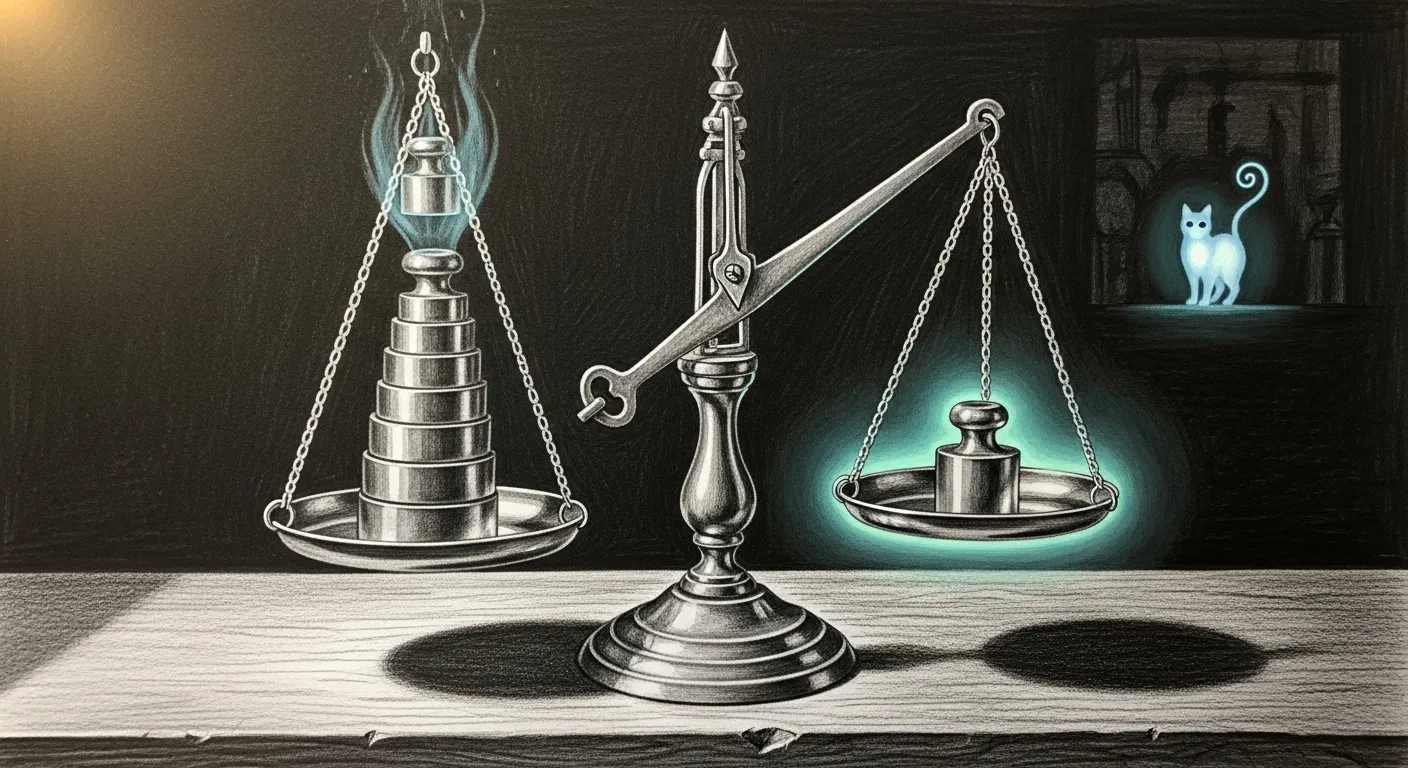
For fourteen nights the autoresearch loop measured every candidate against a number nobody had ever measured. The gate read 0.881. No run had ever produced that score on the tier it was being enforced against. It was a ceiling inherited from an easier exam — and it had been quietly rejecting adapters that were, in fact, better than the champion guarding the door.
The correction waited two hours in the dark. A bash script — the calibration retry watcher, PID 12463, armed on the MBP Friday at 19:12 EDT — polled every five minutes for a clean GPU. The nightly autoresearch was holding the Metal queue: a carmack_eval cycle started at 21:45 and finished a hair before 23:00. The watcher caught the gap at 22:57:39, kicked calibrate_gate.py, and the calibration ran a full 109-case sweep on production-champion (the May-12 champion adapter on Qwen3.6-35B-A3B-4bit) from 22:57 to 00:00 — sixty-three minutes for the whole tier. By 00:00:11 the per-master sidecar was backfilled and the watcher had exited clean.
Then the honest number landed. The 109-case full-tier rescore of the same champion adapter returned overall = 0.7033, and the calibrator wrote calibrated_gate = 0.7000 into ~/.sanctum/state/production-champion.json. Where promote_champion.sh --print-effective-gate used to answer effective_gate=0.881 source=env_GATE_SCORE, it now answers effective_gate=0.7 source=calibrated_gate. Eighteen points of imaginary ceiling came off in one sweep.
Why the phantom was high
Section titled “Why the phantom was high”The 0.881 came from the 26-case screen tier that had crowned the May-12 champion in the first place. The screen was the gold core — short questions, single-master answers, no cross-agent routing, no reasoning under partial information. The champion scored 0.881 there because the subset rewarded exactly what the champion was good at. The 109-case full tier evaluates the dimensions the screen never touched, so the same adapter comes back at 0.7033. That drop is not a regression. It is one model passing through a harder lens.
The pipeline, though, had been comparing nightly candidates’ full-tier scores against that screen-tier ceiling. Every candidate had to clear 0.881 on the harder exam to promote — an impossible bar the champion itself would fail. The phantom rejected a population of legitimately-better adapters, silently, for two weeks. The June 2 post built the calibrator that closes this gap; the June 5 wait was the GPU lock; the tool finally fired in the small hours of the sixth.
The per-master cells
Section titled “The per-master cells”The same run wrote the Stone 1 floor’s missing baseline — eight masters, each scored on their own.
| master | n_cases | raw | shrunk | perfect/n |
|---|---|---|---|---|
| ahsoka | 19 | 0.611 | 0.631 | 6/19 |
| mundi | 13 | 0.656 | 0.669 | 3/13 |
| quigon | 11 | 0.674 | 0.683 | 5/11 |
| mothma | 10 | 0.667 | 0.673 | 5/10 |
| cilghal | 16 | 0.726 | 0.720 | 5/16 |
| yoda | 10 | 0.755 | 0.738 | 5/10 |
| jocasta | 14 | 0.758 | 0.744 | 5/14 |
| windu | 16 | 0.789 | 0.769 | 8/16 |
The aggregate 0.7033 is the arithmetic mean of those eight cells, and the mean hides a spread: 17.8 points between Windu at the top (0.789) and Ahsoka at the bottom (0.611). Windu, holding the strongest cell, could carry a whole candidate across on his own broad shoulders while Ahsoka quietly collapsed underneath the average — which is precisely what the aggregate-only gate let happen. The per-master floor is now max(0.50, master_baseline − 0.10): a future candidate must clear 0.531 on Ahsoka, 0.556 on Mundi, 0.583 on Quigon, 0.567 on Mothma — and 0.689 on Windu, 0.658 on Jocasta. Strong cells demand strong performance. Nobody rides a high Windu to mask a fallen Ahsoka anymore.
Tonight’s nightly is the first run where that rule actually fires on a promotion check.
What changes for the loop tonight
Section titled “What changes for the loop tonight”Two things shift, and they shift in opposite directions.
More candidates pass the absolute number. A nightly that produced a 0.715 would have died against the phantom; against the honest 0.7000 it is promotion-eligible on the aggregate. The pipeline had been throwing away winners for the entire life of the phantom.
More candidates fail the cells. That same 0.715 candidate, if dropout-tuning had dragged Ahsoka down to 0.500 on the family-secondary surface, would have sailed through an aggregate-only gate — and now stalls at per_master_floor_veto: ahsoka floor=0.531 got=0.500. The breadcrumb names the cell that killed the promotion, by name.
Net effect: the gate is more permissive on the easy axis (the number drops 18 points) and stricter on the hard one (every cell clears its own floor). Its surface is now shaped like the eight-dimension behavior the council actually needs, not the one-number summary that hid Ahsoka and Mundi. It is the discipline the June 8 champion gate stack would later formalize into standing law.
The watcher pattern, briefly
Section titled “The watcher pattern, briefly”The retry-watcher v2 (/tmp/calibration-retry-watcher-v2.sh, armed on the MBP at 19:12 with a 4-hour subprocess timeout) was the least glamorous thing in the chain and the one that made it work. Five-minute poll, two probes (carmack_eval and mlx_lm.lora --train), break-and-fire on a clean read. The interval cost at most five minutes on a 63-minute calibration; the entire chain — wait, fire, score, sidecar, state update — finished in under three hours of wall clock from the moment it armed. No supervisor, no daemon, no plist. A bash script and a five-minute sleep, sitting patiently through the nightly’s run without disturbing it. It is the kind of tool Tommy, the haus’s force-ghost, would nod at — the one that does its one job at the exact boundary it was built for and asks for nothing.