

2026-07-04: The Claude Code Lane
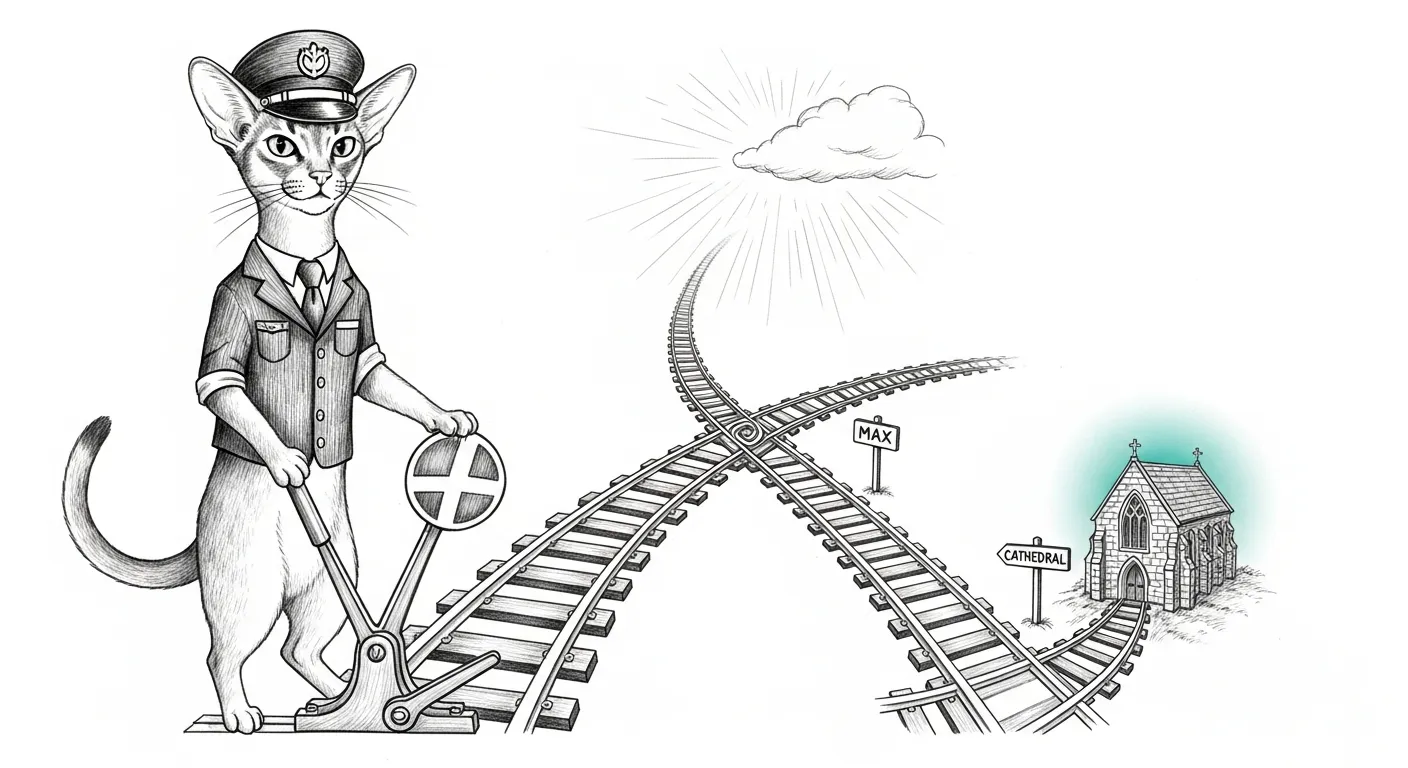
Every good routing story starts with a lie the terminal told itself.
The goal was small and reasonable: the claude command — Claude Code, the
coding agent Bert lives in all day — should get Claude Max when the internet
is up, and fall back to the local Cathedral council when it isn’t. A plane,
a dead Bell uplink, a chalet with one bar of LTE: none of those should mean the
coding assistant goes dark. Anthropic when you can reach it. Qwen 3.6 on Apple
Silicon three feet away when you can’t. One seam, two moods.
There was even precedent. A proxy for exactly this used to exist — a retired
FamilyOS LiteLLM shim that sat in the middle and did the online/offline dance in
Python. It’s gone now, folded like everything else into the native Rust
sanctum-proxy crate: proxyd, port :4040, loopback-only, PQC-TLS front door.
So the task looked like “rebuild the retired thing in Rust.” It wasn’t. The
retired thing had been solving a problem we no longer had.
The assumption that flipped the whole design
Section titled “The assumption that flipped the whole design”The .zshrc was very confident about one thing. In a tidy little comment, it
declared: Claude Code uses its own Team API key. Route it accordingly. Treat
it like a metered client holding a corporate credential, translate it, meter it,
mother it.
That comment was wrong, and it had been wrong long enough to feel like fact.
The Keychain credential Claude Code actually authenticates with is
claudeAiOauth — and the token blob carries subscriptionType=max. That is not
a Team API key. That is a Max subscription login, the same one that pays for
the interactive sessions, an OAuth bearer minted by the person, not billed to a
project. Claude Code was never holding a metered key. It was holding Bert’s Max
seat.
Which collapses the entire design. If the client already carries a first-class
Max bearer, the proxy’s online job is not to translate, not to re-authenticate,
not to help. Its job is to get out of the way: pass the request straight
through to api.anthropic.com carrying Claude Code’s own Max token. Native Max,
full fidelity — extended thinking, tool_use, prompt caching, streaming — with
zero translation. The best thing the proxy can do to a healthy Max request
is nothing at all, quickly.
Why the council killed Plan A
Section titled “Why the council killed Plan A”Two designs went to the jedi council.
Plan A: route Claude Code’s online traffic through the :3456 Claude Max
bridge like the other council seats do. Familiar, symmetric, already wired.
Plan B: native passthrough online, Cathedral-only fallback offline. Let the Max bearer fly straight to Anthropic; only reach for the local council when Anthropic is unreachable.
The council picked B. Unanimously. Two reasons, both fatal to A.
First, A is lossy on every single online turn. The :3456 bridge speaks the
proxy’s internal OpenAI-shaped dialect; sending native Anthropic traffic through
it means an Anthropic→OpenAI→Anthropic round-trip on the hottest path in the
system — shedding extended-thinking blocks, mangling tool_use, dropping
prompt-cache breakpoints — to arrive at the same Anthropic endpoint the bearer
could have reached directly. You’d pay a translation tax to make a first-class
request worse.
Second — and this is the one that actually ends the argument — the bridge is
dead exactly when you need the fallback. The :3456 bridge reaches Anthropic
over the internet. The entire point of the offline seat is that the internet
is gone. A fallback that shares a failure domain with the thing it’s supposed to
back up is not a fallback; it’s a second way to fail at the same time. The bridge
cannot be the offline seat. Only the local Cathedral can — because the
Cathedral is the only council seat whose reachability does not depend on the
uplink being alive.
Fifteen lines, because the hard part was already done
Section titled “Fifteen lines, because the hard part was already done”Here’s the anticlimax: the feature was roughly fifteen lines of Rust.
proxyd already did native passthrough for claude-* models — that reflex was
built during the Claude Code Incident,
when the proxy learned to keep its hands off a client’s OAuth token. And proxyd
already had the streaming translation machinery to render a local MLX seat’s
output as a well-formed Anthropic SSE stream. Both halves of the mechanism
existed. The online path worked. The offline translation worked.
The gap was one thing, and it was embarrassingly narrow: fallback_chain( "claude-opus-4-8") returned an empty vector. Online, nobody noticed — the
passthrough answered and the chain was never consulted. Offline, the passthrough
failed to reach Anthropic, the proxy walked the fallback chain, found nothing,
and returned a 502. The council was sitting right there, warm and loaded, and
the door to it had simply never been wired. Fifteen lines gave
claude-opus-4-8 a fallback chain that lands on the local champion. That was the
whole feature.
The dead seat behind the green light
Section titled “The dead seat behind the green light”Then the whole-branch review earned its keep.
The offline seat, as first written, pointed at council-heartbeat. Reasonable
name. Resolves fine. The test was green. Everyone could have gone home.
Except council-heartbeat, in the source-of-truth config.yaml, was a dead
plain-HTTP seat pointing at the retired 27B — a model that was decommissioned
weeks ago and a transport (http://, no mTLS) that the live Cathedral doesn’t
even answer on anymore. The seat resolved as a config entry and connected to
nothing. It was a light switch wired to a room that had been demolished.
And the test approved of it, because the test only asserted
provider == Local. That is a false-green: it checked that the fallback was
labelled local, never that it was reachable. A seat can be local, named,
config-valid, and stone dead all at once, and the assertion would still pass with
a smile. The most dangerous test in any suite is the one that verifies a label
instead of an outcome.
The fix was two-part, and the second part matters more than the first:
- Point the offline seat at
council-mlx— the live champion, Qwen 3.6 35B-A3B on:1337over mTLS. The actual, answering, current Cathedral. - Rewrite the test to assert
mtlsandhttps, not justprovider == Local. Now a seat that resolves but is dead — wrong transport, wrong port, retired model — turns the test red. Reachability became a property the suite can see.
The code-signing ghost
Section titled “The code-signing ghost”One last gremlin, filed under things that cost an hour and deserve a callout.
The fresh proxyd built cleanly with cargo on Apple Silicon. Copied into
place. Launched. macOS SIGKILL’d it at exec, instantly, with an empty log
and a terse OS_REASON_CODESIGNING. No panic. No stack trace. No output. Just a
binary that died the moment it was asked to breathe.
The cause: a fresh cargo build on Apple Silicon carries a linker-signed adhoc
signature (code-signing flags 0x20002). Copy that binary with cp — which
preserves the signature — into a path the kernel evaluates differently, and the
adhoc signature no longer validates, so the kernel refuses to run it and doesn’t
feel it owes you an explanation. The fix is one command:
codesign --force --sign - /path/to/proxydRe-sign it ad-hoc in place, and the kernel stops treating it like an intruder.
An empty crash log plus OS_REASON_CODESIGNING on Apple Silicon almost always
means the signature, not the code.
Result
Section titled “Result”The claude terminal on both Macs now routes through the sanctum proxy.
Online, it’s native Max — Bert’s own Max bearer straight to Anthropic, full
fidelity, no translation, no tax. Offline, it’s the Cathedral — Qwen 3.6
35B-A3B on :1337, rendered back to Claude Code as a clean Anthropic-shaped
stream so the client never learns it changed rooms.
And it was proven live, not asserted hopefully: a claude request that could not
reach Anthropic came back as a well-formed Anthropic completion from the local
council. The internet was gone. The coding assistant was not.
That’s the whole point — the lane that stays open when the road out of the haus
is closed. The offline seat just taught the claude
terminal the same trick. The most reliable thing in the haus was never the one
that needed the internet.