

2026-04-27: The Vajrayogini Cut
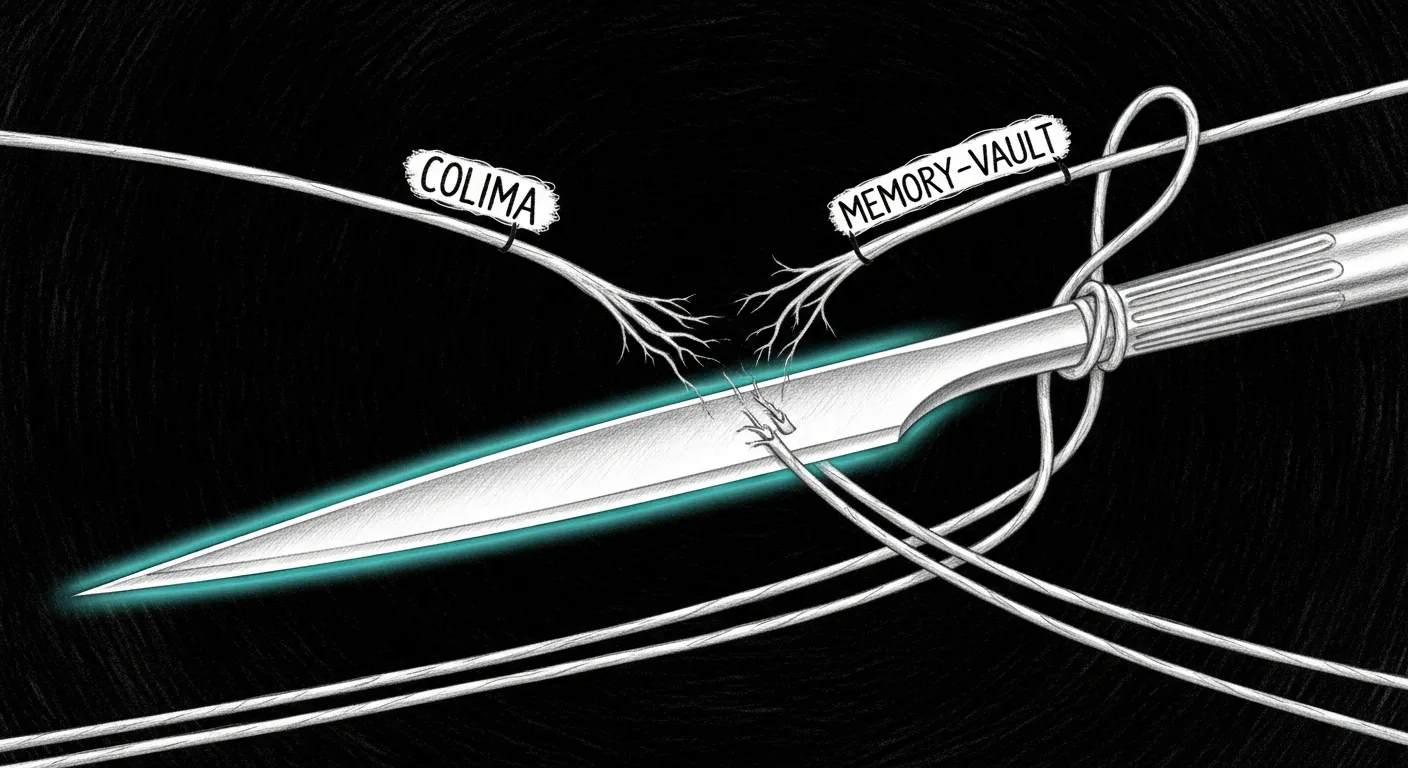
Vajrayogini carries a curved knife. It is not drawn for enemies. The iconography turns it inward — to sever the two threads of your own delusion in one motion, so cleanly that neither grows back. Two threads were still bleeding when this session opened, both named the night before in the 2026-04-26 trilogy redux and both left un-cut. We had described them well and fixed neither. By the end of the night both were closed at the root, not papered over.
Issue one: Colima 0.10.1 → OrbStack
Section titled “Issue one: Colima 0.10.1 → OrbStack”The symptom was already on record. colima ssh reports a healthy Docker daemon and healthy containers, yet the host couldn’t reach 127.0.0.1:8123 or 127.0.0.1:3100, because Lima’s host-side TCP forwarding died within minutes. The smoking gun in ~/.colima/_lima/colima/ha.stderr.log was failed to set up forwarding tcp port 8123: exit status 255 — the SSH ControlMaster connection backing Lima’s port forwards was dropping, and colima restart only bought ~3 minutes of uptime before the master died again. 0.10.1 is the latest Homebrew stable; there is no upgrade to reach for.
Three options had been on the table:
- Migrate to OrbStack (drop-in Docker replacement, native networking)
- Bind containers to the bridged vmnet interface
- Add a watchdog action that detects the symptom and runs
colima restart
A daemon that restarts a broken thing every few minutes is not a fix — it is a confession you decided to put on a schedule. Steve Jobs would reject it on sight. So we picked option one. Replace the broken thing.
What changed
Section titled “What changed”brew install --cask orbstackOrbStack is the Apple-platform-native Docker replacement built by ex-Docker-Mac engineers. Native virtualization, native networking, no SSH-forwarded ports — which is to say, nothing left in the path that was breaking.
Migration steps:
- Audit data risk. HA’s volumes are bind-mounted to
/Users/neo/.openclaw/homeassistanton the host filesystem — survives an engine swap. Outline’s volumes (postgres, redis, minio, outline-data) live inside the Colima VM — they need backup-and-restore. - Backup outline.
pg_dumpto a host SQL file; tar minio + outline file storage; copydocker-compose.yml+.env. All four artifacts live at~/.sanctum/backups/outline-pre-orbstack-20260427-1909/. - Stop Colima containers cleanly.
colima ssh -- docker stop $(docker ps -q). - Switch DOCKER_HOST.
~/.zshrcupdated to point atunix:///Users/neo/.orbstack/run/docker.sock. Comment in the file dates the swap. - Bring HA up under OrbStack. Same compose file, no edits. Live in 3 seconds, port
:8123answering 200 with no Lima fragility underneath. - Bring outline up under OrbStack. Backing services first (postgres + redis + minio), drop the auto-init outline DB, restore from
pg_dump, rename the temp DB tooutline, restore minio + file-storage tars, start outline app. - Stop Colima entirely.
colima stop. Containers are no longer needed in the Lima VM. - Update the watchdog runtime catalog.
colima-restart-then-upactions becomeorb-restart-then-up; comments updated to reflect that under OrbStack,compose-upis fast and idempotent and the daemon-restart path is for daemon-level edge cases only.
The signal-cli stack that was retired in the yoda-chat consolidation (2026-04-26) was deliberately NOT brought up under OrbStack — nothing live consumes its ports. Forgotten work shouldn’t disappear, but neither should it spin without a consumer. The data lives bind-mounted at ~/.openclaw/signal-cli/data-{rest-api,yoda} if a future session ever wants it back.
Issue two: phase-4 valve — shed-effectiveness gating
Section titled “Issue two: phase-4 valve — shed-effectiveness gating”The memory-vault re-shed loop was the SIGSTOP redux one layer up, and it wore the same tell. The valve sheds memory-vault on every ORANGE tick. launchd respawns it. Swap stays at 26 GB. The valve hits ORANGE again on the next cooldown, sheds again. 3 sheds in 12 minutes that day, 10 across the prior four days. The shed succeeded every time. Not one of them did anything.
That is the exact delusion vajrayogini cuts: a remediation you cannot observe in the signal it claims to relieve. If the last N applications didn’t move the metric, escalate or stop — don’t keep swinging at the same knot and calling the swing a fix.
What ships
Section titled “What ships”A new effectiveness.rs module in sanctum-pressure-valve:
- When a
Shedaction fires, the valve recordspre_swap_mband the cooldown deadline. - Every subsequent tick after the deadline, the valve compares current
swap_used_mbtopre_swap_mb. If the delta is belowSHED_DELTA_MB(100 MB — well above measurement noise), the shed is recorded as ineffective. - After
MAX_FAIL_STREAK_BEFORE_SKIP(2) consecutive ineffective sheds for the same label, the planner skips that label forINEFFECTIVE_WINDOW_SECS(30 min). Single-data-point false positives don’t trigger; runaway loops close within minutes. - After the window, the marker decays and the label is reconsidered fresh.
The planner in action.rs::plan now takes a closure: is_label_ineffective: F where F: Fn(&str) -> bool. The closure is called for each TIER_3 / TIER_2 candidate; ineffective labels are skipped, the iteration falls through to the next label or to Noop. Tests pass |_| false to recover the pre-phase-4 behavior.
The heartbeat at ~/.openclaw/state/sanctum-pressure-valve.json gains an ineffective_targets: [(label, secs_remaining)] field, only serialized when non-empty so quiet operation produces a quiet heartbeat.
Five new unit tests cover the module — effective_shed_clears_streak, two_ineffective_sheds_skip_label, ineffective_marker_decays_after_window, pending_evaluations_only_fire_when_due, snapshot_lists_active_skips. 49 valve tests pass total; clippy -D warnings clean. Live-deployed on manoir.
What’s whole now
Section titled “What’s whole now”Held against the capacity doctrine — “closed-loop, honest, bounded, defense-in-depth, fix root cause in layers”:
- HA + outline reachable from host — closed-loop (OrbStack’s native networking is the loop), no SSH ControlMaster fragility, no daemon to fight every 3 minutes.
- Family-facing services don’t lie — honest (OrbStack reports failures up; the watchdog reports them up).
- Memory-vault re-shed loop — closed (phase-4 measures and closes the loop).
- Valve action is observable in its target signal — defense-in-depth (the valve now reports its own effectiveness, not just its own activity).
Honest gaps that remain
Section titled “Honest gaps that remain”- Memory pressure root cause is structural: 64 GB Mini at 26 GB swap with LM Studio coder-14b (8.4 GB), sanctum-mlx 35B (varies), Colima retired. Phase-4 closes the loop’s noise, but doesn’t invent more RAM. A future session may need to evict at the next tier (KillAllowed) or reduce the resident model footprint.
- Watchdog still references colima in some places (catalog updated; legacy boot scripts and Living Force manifests cleaned in a follow-up). Documented as such; not blocking.
- OrbStack failure mode is unknown — every tool fails differently. The first OrbStack flap will teach us its character; until then we’re trusting it on reputation.
Two threads, one cut. The blade doesn’t pretend the room is clean now — Colima left a memory-pressure problem it was only ever hiding, and OrbStack is trusted on reputation until its first flap says otherwise. What changed is smaller and truer than that: nothing in the family’s path to Home Assistant breaks every three minutes, and the valve can finally hear whether anyone is listening when it sheds. Pick, ship, document. The rest waits for a session that isn’t tonight’s.
Related
Section titled “Related”- Pressure Valve — the doctrine and configuration, now with phase-4
- 2026-04-26 — Pressure-Valve Trilogy Redux — the SIGSTOP loop fix that named both of tonight’s issues
- 2026-04-27 — Two Gates, One Subscription — the morning’s claude-max-proxy convergence
- Capacity Doctrine — the framework all three daemons enforce
- Node Topology — symmetric admit + valve + claude-max-proxy across hub and mobile