

2026-04-27: Two Gates, One Subscription
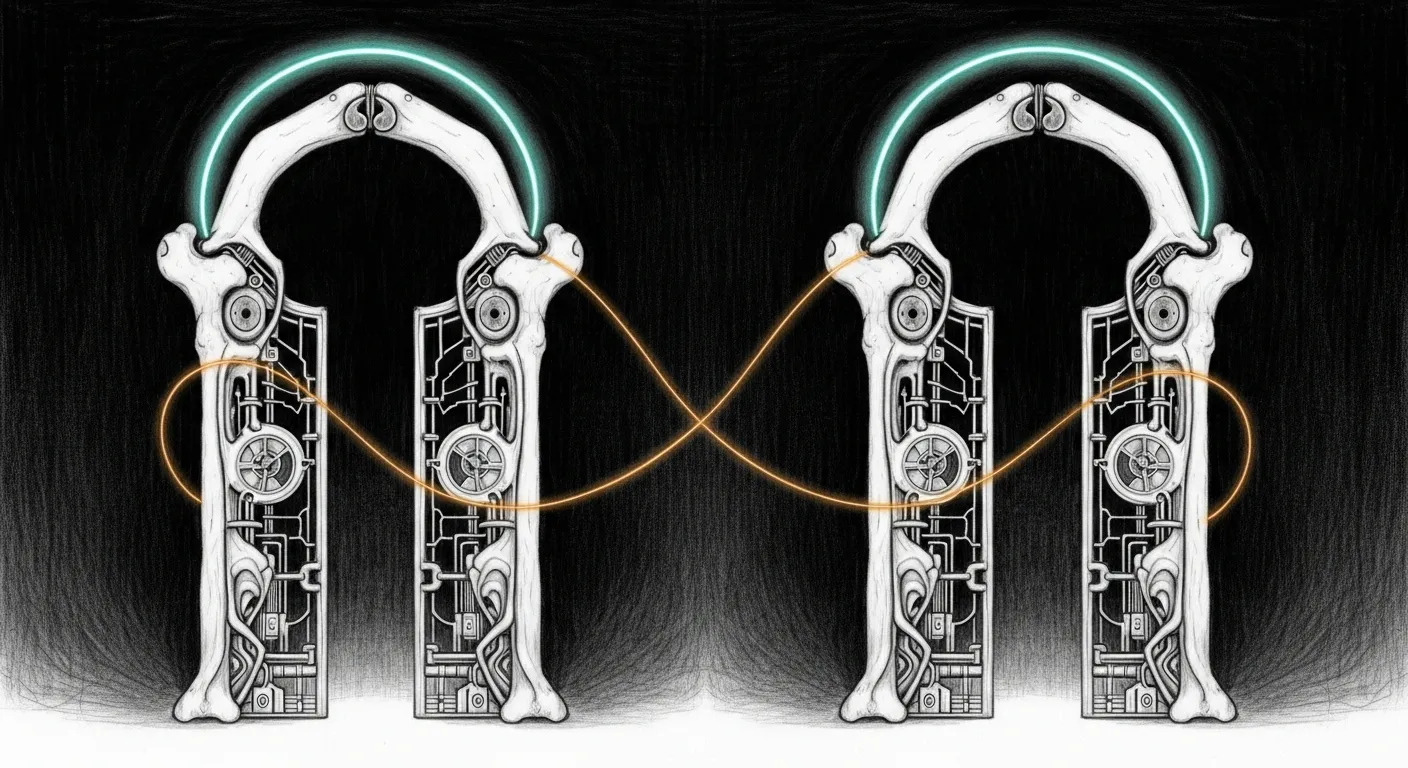
Two Macs. One Claude Max subscription apiece. Until this morning they disagreed about how to spend it.
The capacity doctrine that landed 2026-04-24 said each host answers for its own air supply. Three daemons enforce it: sanctum-admit for the RAM pool, pressure-valve for shedding offenders, and the Claude proxy for cloud-backend routing. The first two were already symmetric across the hub and the mobile node. The third was the holdout. Today it fell into line.
What was wrong before
Section titled “What was wrong before”The hub ran com.sanctum.claude-cli-proxy on :2001. Each request spawned /Users/neo/.local/bin/claude as a fresh subprocess, parsed the response, and returned it. CLI cold-start was 10+ seconds. Yoda’s voice ladder treated it as a fallback because the latency budget couldn’t tolerate it as primary. The footer of llm_client.py said so out loud.
The mobile ran com.sanctum.claude-max-proxy on :3456 — a long-lived HTTP server from the claude-max-api-proxy npm package, wrapped by claude-max-api-tailscale.js to bind the Tailscale IP. Persistent process, fast warm path, and the smart-router cathedral’s cloud backend talked to it without complaint.
Two implementations, two routing topologies, two operational profiles, one Claude Max subscription on each host. The asymmetry pre-dated the capacity doctrine and never got cleaned up.
What changed
Section titled “What changed”pnpm add -g claude-max-api-proxyPnpm. Not npm. Sanctum has been pnpm-only since the 2026-04-14 migration; npm install -g reintroduces lockfile drift the migration was designed to kill.
A wrapper at /Users/neo/.sanctum/bin/claude-max-api-tailscale.js mirrors the mobile’s wrapper exactly, but binds 0.0.0.0:3456 so localhost callers (Yoda, sanctum-server) and tailnet peers both reach the same listener. The mobile’s wrapper binds explicitly to the Tailscale IP because 0.0.0.0 had silently failed for cross-tailnet callers there; the hub didn’t reproduce that quirk.
A new launchd plist com.sanctum.claude-max-proxy replaces com.sanctum.claude-cli-proxy. We keep the retired plist and its script at ~/Library/LaunchAgents/retired-2026-04-27/ and ~/.sanctum/scripts/retired-2026-04-27.claude-cli-proxy.js — kept, not deleted, because forgotten work shouldn’t disappear.
Five consumers migrated from :2001 to :3456:
sanctum-proxy/config.yaml(now-retired but kept coherent)yoda-voice-agent/orchestrator/llm_client.py(default and source string)yoda-voice-agent/orchestrator/server.py(env default)yoda-voice-agent/plists/com.sanctum.yoda-orchestrator.plist(YODA_MAX_URL)yoda-voice-agent/tests/e2e/test_orchestrator_turn.py(assertion)
After the orchestrator reload, launchctl print confirms YODA_MAX_URL => http://127.0.0.1:3456 — Yoda now points at the local listener by default. We asked the fresh proxy the only question that matters: a live curl to :3456/v1/chat/completions returned Yes — alive and ready.
Per-host symmetry
Section titled “Per-host symmetry”| Daemon | Hub | Mobile | Why on both? |
|---|---|---|---|
com.sanctum.admit | :2189 | :2189 | Each host enforces its own RAM ceiling. |
com.sanctum.pressure-valve | running | running | Each host sheds its own offenders. |
com.sanctum.claude-max-proxy | :3456 | :3456 | Each host has its own Max OAuth session. No cross-machine routing required for local consumers; tailnet routing remains available for failover. |
The cathedral’s cloud backend gains a hub-side fallback that didn’t exist before: if the mobile is asleep or rebooting, the hub’s proxy can serve its own traffic. The node topology now lists this proxy among the services that stand on both hosts rather than leaning on one.
What’s next
Section titled “What’s next”- Smart-router HA: declare the hub’s
:3456as afallback_urlon thecloudbackend so failover is automatic, not manual. - Persistent daemons across the chalet’s third Mac mini once it comes back online (offline since 2026-03-16).
- Observability: a per-host
claude-maxquota dashboard so OAuth-rate-limit pressure is visible before it fires.
Related
Section titled “Related”- Node Topology — added a “Persistent Services Across Hosts” section that names this convergence
- Capacity Doctrine — the 2026-04-24 framework this completes
- Smart Router Cathedral — the
cloudbackend that consumes both proxies