

The Controller, Quiet
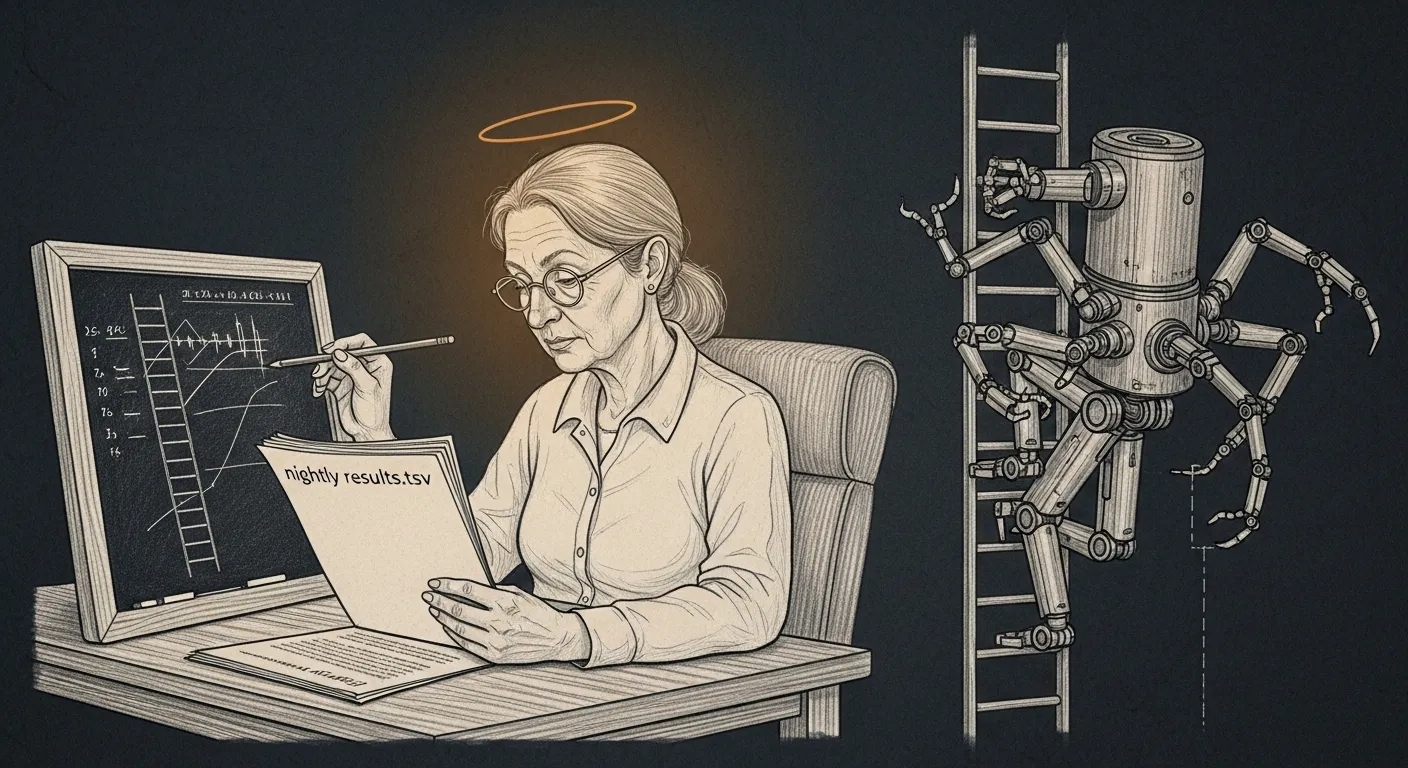
Autoresearch had a picker. The picker walked a ladder of training configurations and tried them in order. Every night. Forever. The order was decided by a human, once, in a Python list.
The ladder — the one that heals itself — is twelve rungs now. Two of them — recipe-real-only and recipe-replay-boost — vary the training data instead of the hyperparameters (Stage 1, yesterday). The picker still walks in order. It does not know that one rung’s recipe scored 0.860 last night and another’s scored 0.612 the night before. It just walks.
So we gave the picker a roommate. The controller runs once, before the picker, every night. It reads results.tsv for the last hundred runs. It reads eval_results_full.json for every adapter that has one. It groups by recipe, finds the weakest tier in the most recent measurement, identifies which recipe historically lifted that tier most, and decides which ladder rungs to suppress so the picker walks to the rungs that match.
Then, by default, it writes that decision into a log file and exits 0. The picker walks the full ladder, as if the controller did not exist. The training proceeds. The controller, quiet.
A first transcript
Section titled “A first transcript”Tonight, against real data, the controller produced this:
{ "mode": "shadow", "skip": ["champion-replay", "champion-converge", "long-seq", "rank-64", "higher-lr", "rank-128", "safe-baseline", "more-iters-400", "rank-32", "rank-32-iters", "recipe-real-only"], "rationale": "eps-greedy (exploit, e=0.1): targeted: weakest tier=extended, best recipe by mean overall=replay-boost (0.860); keeping 1 rungs, skipping 11", "history_rows": 81, "evals_present": ["exp-20260522-220232", "exp-20260522-214052", "exp-20260512-170902"]}A single JSON line in logs/controller-shadow-20260523.log. Eleven rungs the controller would have suppressed; one — recipe-replay-boost — the controller would have kept. No rung was actually suppressed. The shadow log is the entire mechanism: a daily transcript of what the autonomy would have done if it had been allowed to act.
The transition
Section titled “The transition”Shadow → active is one shell command:
touch ~/.sanctum/autoresearch-controller-activeKill switch is one shell command:
rm ~/.sanctum/autoresearch-controller-activeBoth are deliberate. Neither requires a code change, a plist edit, or a deploy: you touch a file to hand the controller the wheel, and you rm it to take the wheel back. The controller reads the sentinel state once at the top of its run; toggling the file mid-night cannot flip the decision halfway through.
The cardinal rule
Section titled “The cardinal rule”A controller failure can never crash the nightly. The entrypoint is wrapped in a try/except Exception that logs the traceback to a separate error file and exits 0 regardless. The orchestrator’s invocation appends || true for belt-and-suspenders. Five failure-isolation tests — missing results.tsv, malformed results.tsv, malformed eval JSON, strategy raises, sentinel state read only once at start — were the Jedi Council’s explicit condition for approval, and the cardinal rule held on every one of them.
A fragile feedback layer is more dangerous than no feedback layer. The closed loop must fail invisibly; the autoresearch nightly that has been running unattended since April must keep running unattended whether the controller is healthy, sick, or absent.
The strategy
Section titled “The strategy”The choice of ε-greedy targeted as the v1 default came from the Council. Pure exploit (no exploration) would lock in on the first apparent winner, and the recipe library is small enough that early lock-in is the realistic failure mode. So the default rule is: exploit ninety percent of the time, explore ten percent. ε is one env var away from being something else.
The strategy is pluggable. The interface is one abstract method —
def decide(history, evals, ladder) -> tuple[list[str], str]: """Return (rung_ids to skip, human-readable rationale)."""UCB and Thompson sampling are designed-for, not built — the night the bandit picks first is when that swap leaves the drawing board. When the recipe library grows enough that sample-size confidence matters, the swap is a single subclass.
The library is the rate-limiter now
Section titled “The library is the rate-limiter now”The controller has three recipes to choose among, two of which produce essentially the same dataset. The real Phase 2 question — does varying the data improve held-out generalization? — needs recipes that actually vary the data. That work is operator-side: more real-session captures, more category packs, real data/raw/replay.jsonl.
The controller will be waiting when the library catches up.
For now: the loop is closed. The picker has a roommate. The roommate is quiet.
Phase 2 Stage 2 shipped 2026-05-23 (council-autoresearch merge 8718452). Spec at docs/superpowers/specs/2026-05-23-autoresearch-closed-loop-design.md. Default state: shadow. Activation: deliberate.