

2026-07-02: The Lights Go Local (and the Names That Wouldn't Stick)
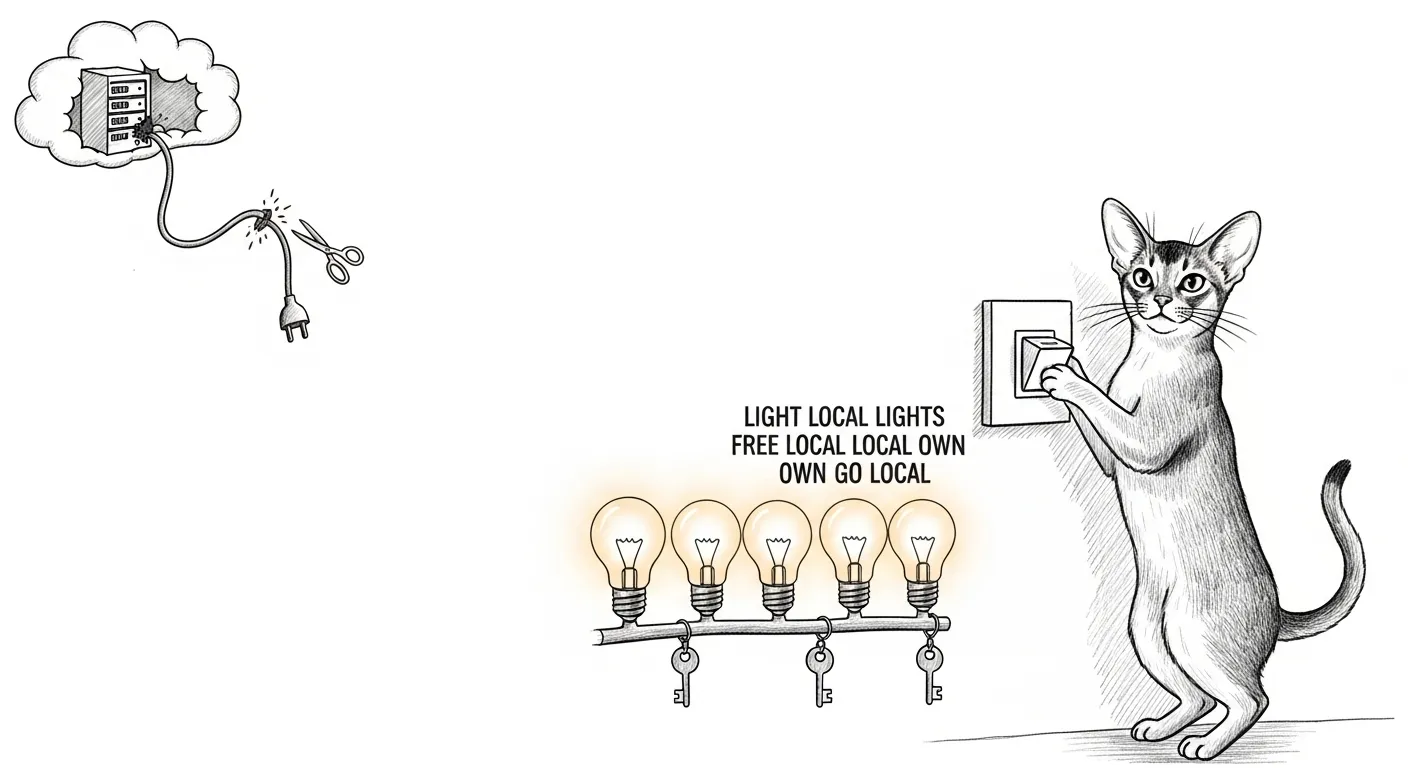
The bulbs were hostages. Every few weeks the Tuya cloud login expired, and until someone re-authenticated an app on a phone, the house’s lights answered to no one. The durable fix was never “log in again faster.” It was cut the cloud out of the loop entirely — talk to the bulbs on the LAN, with their own keys, forever.
Local or it didn’t happen
Section titled “Local or it didn’t happen”Fifty device localKeys were already extracted. LocalTuya went onto the HA Green.
But before wiring a single entity we did the thing that separates configured from
controllable: we opened a socket to a real bulb and turned it off and on.
GameRoom 4 blinked. Local read and write, zero cloud, proven — then and only then
did the integration get built on top of it.
The DP layout wasn’t guessed, it was measured (20 on/off, 22 brightness,
24 colour, and so on), then cross-checked against LocalTuya’s own schema. The
config entry was hand-merged into core.config_entries with the blast radius you’d
expect from editing Home Assistant’s brain: HA stopped first so its shutdown
save couldn’t clobber the edit, a full backup taken, the written file read back
and compared byte-for-byte, and an automatic rollback armed.
Second pass, clean: 9 lights live, every one answering Home Assistant. The proof
of done wasn’t “the integration loaded” — it was light.turn_off flipping a
physical bulb and the state round-tripping back from the device. And the six
bulbs that looked “unreachable” earlier? Not powered off — their DHCP leases had
drifted after a week of reboots. LocalTuya now tracks that drift on its own.
The names that wouldn’t stick
Section titled “The names that wouldn’t stick”Which surfaced the next indignity: in the Firewalla, every one of those bulbs read
espressif or, worse, wore a stolen name — a light labeled Marantz NR1609,
another Bert's Echo Show, a third Bert's Macbook Air — the router’s best-guess
heuristic bleeding nearby names onto the wrong hardware. So we built Columbo: a
resolver that fuses every clue (the Tuya keyset, whose device-ids embed the MAC;
Home Assistant; DHCP; vendor) and gives each device
the name that means who it is.
The dry run was a quiet triumph — 27 devices named authoritatively, the
cross-contamination corrected.
Then Columbo wrote them, and reported 35 of 35 written and verified.
It was lying, and the persistence check caught it. A spot-read three minutes later showed all 35 reverted to blank. The Firewalla’s HostManager periodically re-saves its in-memory copy of each host and wipes any name set out-of-band through raw Redis. Only one survived — the one bulb we’d been toggling, because that activity forced the router to reload it and pick the name up properly. The same reversion would ambush us again weeks later, when blocked devices kept unblocking themselves: the firewall’s own state machine, winning every write that didn’t go through the front door.
So Columbo’s brain ships and is proven; its Firewalla write waits for the correct path — the router’s own host object, not a Redis poke — rather than a midnight hack against the live box that just spent a week misbehaving. The daemon is built and deliberately disabled until it can persist for real.
The lights obey locally now. The names are next.