

The Cathedral Holds Two Minds
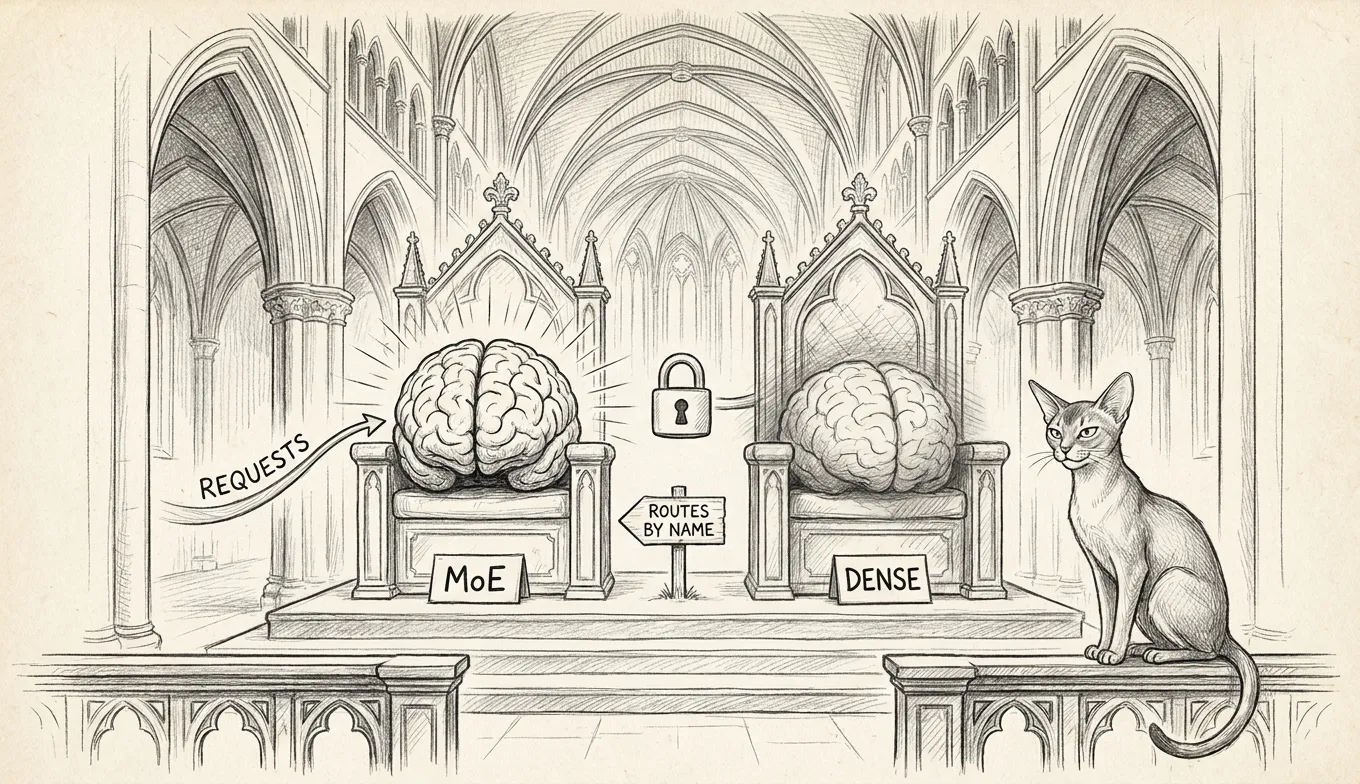
The Cathedral has spent its life serving one model at a time. It doubled its seats once (Devstral, Cilghal-Heretic, and a main), but those were separate processes on separate ports — three tenants, three leases. This is different: one process, one port, two full models, and a request chooses which mind answers it by name. It is the kind of thing that sounds reckless right up until the moment you realise the machinery was already 90% there, waiting, with a #[allow(dead_code)] on it.
Why two minds
Section titled “Why two minds”We benchmarked the dense 27B against the 35B-A3B MoE champion on the honest 109-case eval and, after a properly rubric-grounded pairwise re-judging, they came out statistically tied — 14 wins each, 0.714 vs 0.705 overall. The MoE is 3.7× faster (45 vs 12 tok/s on the Mini). The dense model is easier to fine-tune and edges the leakage-resistant heldout tier. When two models are peers on quality but differ on speed and temperament, picking one is leaving value on the table. So we stopped picking. Route the workhorse traffic to the fast MoE, route the hard calls to the deep dense reasoner, and let the request decide.
How it works
Section titled “How it works”| Piece | Behaviour |
|---|---|
AppState.primary + secondary | Two ResidentModel bundles in one process. Secondary is Option — absent means the server is byte-identical to its old single-model self. |
| Routing | The OpenAI model field, matched by directory basename. Unknown or absent name → primary, never a 404 (this is load-bearing: the canary and parity probes send stale names and must keep working). |
| The one lock | Both minds share a single GPU-dispatch mutex on the single MLX inference thread. They physically cannot touch Metal at the same time. This is the same lock that ended the SIGABRT era; dual-residency just gives it a second customer. |
| Readiness | The primary flips ready the instant it warms. A sick secondary can no longer hold the healthy primary hostage — only requests naming the secondary wait. |
| Manifests | Both models are ed25519-signed and fail-closed at boot. A bad-signature secondary exits before a single weight loads. |
The memory hack, and the kernel that nearly said no
Section titled “The memory hack, and the kernel that nearly said no”Two 4-bit checkpoints is 19 GB (MoE) + 15 GB (dense) = 34 GB of weights. The Mini has 64 GB and is not empty. There is no per-buffer wiring API in our vendored MLX — we checked, exhaustively; the residency set is one global thing the allocator keeps to itself. So the “hack” is embarrassingly humble: load order. The primary materialises first and wins the wired set; the secondary loads after and pages out under pressure. In the soak, both-resident RSS sits at ~22 GB, not 34 — the idle mind is on the SSD until someone calls its name.
What shipped, and what didn’t
Section titled “What shipped, and what didn’t”Merged to main as a dark land: ten commits, every task spec-and-quality reviewed plus a whole-branch pass that caught two bugs the per-task reviews couldn’t see. Single-model deploys are unaffected. The dual configuration lives in a staged plist that is never bootstrapped — it does not run until someone measures the memory ceiling on the actual Mini during a soak and decides, deliberately, to cut over.
That is the whole point of a dark land: the code is in the building, the lights are off, and turning them on is a separate, sober decision. The Cathedral now can hold two minds. Whether it will, on the 64 GB machine that also runs a coder model and a VM, is a number the soak is currently measuring — one probe every ten minutes, for a day.
Tommy watches the soak from the altar rail, unimpressed, as he watches everything. Fifteen years of dawn patrols taught him that a haus does not need more minds; it needs the one it has to stay warm. On that, at least, the architecture agrees with the cat: whatever the ceiling turns out to be, the primary never cools.