

2026-07-03: Closing the Gaps — the beta-blocker sweep
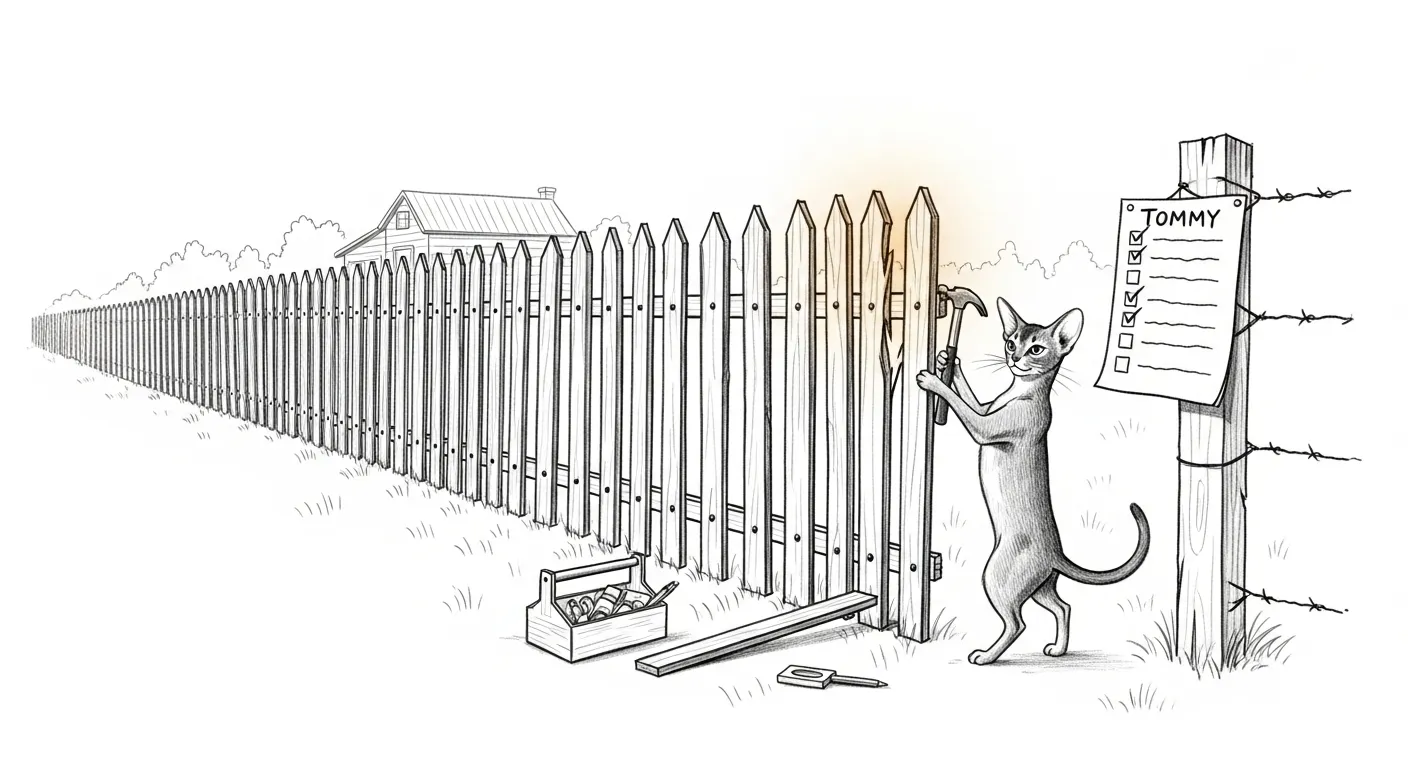
A stranger was about to walk into the haus.
Before a friendly beta tester touched sanctum, we ran the whole estate through a full-body audit — every service read for the failure that lies, the secret that goes missing on uninstall, the router that treats a rate-limit like a fatal error. It is the same walk Tommy did for fifteen years at dawn, checking the fence for a gap that opened overnight. The audit surfaced 28 beta blockers. This is the sweep that closed them — and, just as importantly, the ones it deliberately didn’t close. If you are the one running the beta-readiness ledger, start here.
The doctrine: verify before you attribute
Section titled “The doctrine: verify before you attribute”The most valuable rule in the whole sweep was the one that stopped work. We read every finding against the live code before changing a single line, because an audit is a set of claims, not a set of facts — the same discipline that day’s sibling note, verify before you fortify, was built on. That check paid for itself several times:
- The proxyd UTF-8 truncate panic — a real, nasty class of bug (a multibyte char straddling a byte-slice boundary crashing the request handler) — was already fixed in the tree, char-boundary back-off and a passing test included. A blind “fix” would have churned code that was already correct.
- The Force Flow dedup collapse looked like a bug: two distinct incidents that differ only by an IP or a counter hash to the same key and the second is suppressed. But that normalization is deliberate — it exists because the 2026-06-12 bridge roam paged three times, each message carrying a different streak count. Narrowing it to keep incidents apart directly re-opens the flapping-spam it was built to kill. That’s a product tradeoff, not a defect.
- The rate-limit “severity blindness” was mostly already handled: the critical and P0 tiers — the only ones that wake anyone — already bypass the hourly cap by doctrine. Only dashboard-tier alerts are ever throttled.
Three “major” findings that a less careful sweep would have “fixed” into regressions. Windu would have flagged the same thing: a gap you close by re-opening an older one is not a fix. Verifying first is not slower; a retraction is slower.
What closed
Section titled “What closed”Nineteen findings fixed and merged. The themes read like a list of small lies the estate had been telling itself:
| Theme | Representative fixes | Where |
|---|---|---|
| Signal honesty | cost estimate read 100× low (cents-as-dollars); a tripped breaker latched Open forever; Force Flow logged “delivered” before delivery, and after the cooldown recorded it; alert log survived an inode swap; alerts JSON written atomically | force-flow, proxyd budget |
| Router truth | server /health no longer reports “ok” while routing to a dead backend; a generate call now has a timeout; a 429 fails over instead of aborting; think-buffer content is flushed on stream end, not dropped | sanctum-server |
| Provider health | a 200-then-dropped stream is recorded as a failure, so a flapping backend’s breaker can finally open (it was hard-coded success before) | proxyd |
| Secrets custody | uninstall now revokes the keys it actually wrote (the list had drifted — gemini-api-key was never a real entry); the DR bundle carries the restic passphrase that decrypts the very backups it pairs with; onboarding writes the 1Password credential over stdin, never on argv where ps can see it | sanctum-cli |
| Family safety | the screen-time enforcement suite — weekend-night boundary, reaper hour, credit-balance restore on restart, manual-block reconciliation | sanctum-screen-time |
Every fix ships with a test that fails without it. The stream-health fix, for
instance, drives a wrapped stream over [Ok, Err] and asserts the provider’s
error rate rises above zero — the exact signal a hard-coded success: true
erased.
What’s staged, and why it needs one root command
Section titled “What’s staged, and why it needs one root command”Four fixes live in the proxyd binary, which runs as a system LaunchDaemon. They’re built, tested (37 green), signed, and staged at the deploy path — but proxyd is the root gateway every council model sits behind, and this haus does not hot-patch a root daemon from an agent shell. They land on the next proxyd restart:
sudo launchctl kickstart -k system/com.sanctum.proxydThe four: dead injected fallback chains removed (they pointed at retired
endpoints; real fallbacks come from config now), prefixed model names routed
through the full routing stack instead of exact-match-or-bust, a hot-reload
warning that mTLS/budget/memory changes still need a restart, and the
stream-health honesty fix above. RunAtLoad is set, so a cold boot also lands
them — the kickstart is just the faster path.
What was deferred — with reasons, not silence
Section titled “What was deferred — with reasons, not silence”Five findings were left open on purpose. A deferred-with-reason is always preferable to a rushed fix in the wrong place:
- Two cathedral inference edges (a prompt-cache save-back token/KV skew on a MaxTokens stop; a speculative-decode draft-cache truncate) are real, but they live in the 35B inference hot path. This codebase’s history — the T_q=1 SDPA divergence, the QK-norm decode corruption, the fused-QKV view aliasing — says inference-internal edits go through the dense-vs-MoE parity harness on the dev box, never a hot-patch to the live model during a beta-stability freeze. They’re queued for a dedicated cathedral correctness pass.
- The two Force Flow findings above are working-as-designed tradeoffs that need an operator’s call on the false-page/false-silence balance, not a unilateral edit.
- The net-heal hardening belongs to another session actively working that surface; stomping it would be its own incident.
The honest scoreboard
Section titled “The honest scoreboard”The readiness ruler is
machine-checkable and it does not round up. As of this sweep: 19 fixed, 4
staged, 0 open, 5 deferred. The only thing between the ledger and all-green is
that one root kickstart — everything else is merged, tested, and either
deployed or deferred with a paper trail.
A stranger can walk in now. The fence has one picket still leaning against the post, labelled and waiting for the restart that seats it, and five gaps left open on purpose with a note pinned to each. That is not the same as no gaps. Point-in-time hardening is a snapshot; the ledger, the ruler, and the paper trail are what make the snapshot worth trusting. Tommy would have walked it twice anyway.