

Sanctum Firewalla
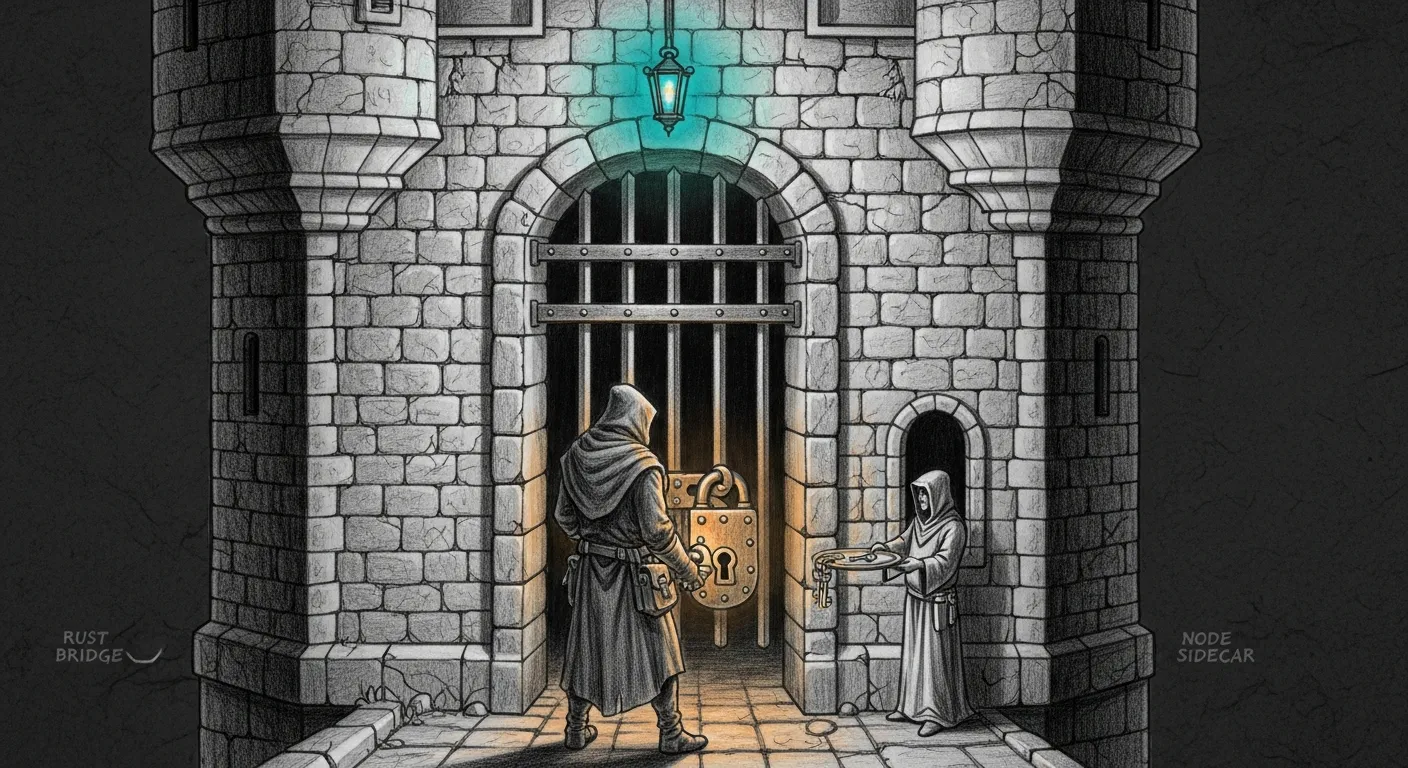
One evening in May 2026, an Apple TV in the den stayed online for two and a half hours past curfew. The bridge that was supposed to have paused it reported success. It had not paused anything. A stale WebSocket and a Connection-Reset had slipped through the gap between two of its several dozen try/catch blocks, and nobody noticed until a kid was still watching well past bedtime.
That is the whole case against the old bridge, in one sentence: a bridge defended one try/catch at a time is only as honest as the developer who last counted them.
The old bridge is ~/.openclaw/firewalla-bridge.js — roughly 1,500 lines of Node.js that wrap Firewalla’s encipher WebSocket SDK and expose an HTTP surface on port 1984. For three years it carried the haus’s screen-time enforcement. It worked. It even worked defensively — dozens of try/catch blocks, retry ladders, /health-honesty plumbing. But two production incidents in 2026-05 — the bridge-500 socket-stale episode and the 2026-05-30 partial-pause Connection-Reset that stranded that Apple TV — priced out the real cost. Load-bearing logic. Single-process JavaScript. Zero test coverage. The Rust port answers all three: it lives in the sanctum-firewalla crate of the sanctum-rs workspace, on the feat/firewalla-bridge-rust-port branch.
Why not “just rewrite it in Rust”
Section titled “Why not “just rewrite it in Rust””Because the encipher SDK will not let you. It is JavaScript-only, undocumented at the protocol level, and reverse-engineering its WebSocket handshake into a Rust crate is a research project of its own. So we did not fight it. We quarantined it.
The shape is a Rust HTTP+SSH bridge with a Node sidecar for the SDK, the same split the haus uses elsewhere. Rust owns roughly 95% of the logic: HTTP serving, bearer auth, the SSH executor, discovery, persistent state, metrics, retry policy, request multiplexing. Node owns the ~5% that has to touch the SDK — a ~190-LOC sidecar process Rust spawns and drives over line-protocol JSON on stdin/stdout. The wire contract lives in services/sanctum-firewalla/docs/SIDECAR_IPC.md, and the whole arrangement is disposable. When a Rust crate for encipher appears, the sidecar gets deleted and the sdk module dispatches calls directly.
The 24-endpoint contract
Section titled “The 24-endpoint contract”The Rust bridge is byte-compatible with the Node bridge on every endpoint haus-control (formerly screen-time) and the sentinels call, save two deliberate divergences. The contract lives at services/sanctum-firewalla/docs/API_CONTRACT.md and is the load-bearing spec for the cutover.
/healthis publicly accessible; everything else requires bearer auth (Authorization: Bearer <token>, token resolved at boot from$FIREWALLA_BRIDGE_TOKENenv then macOS keychain).- 24 endpoints total: host inventory + state, policy management, MAC pause, feature toggles, DNS, alarms, stats, flows, speedtest, export.
- Two intentional contract changes versus the Node bridge:
Policy already existsreturns HTTP 200 with{success: true, alreadyExists: true}instead of HTTP 500. The Node bridge treated Firewalla’s “this rule is already in place” reply as an error. Every caller was already retry-looping over it. The tax was ~355 false-error log lines per day. The Rust port normalises this to a success-with-flag./pingmoves into the public (no-auth) subrouter alongside/health. In the Node bridge/pingsits behind the bearer gate; the Rust port treats it as a liveness probe. This is a deliberate divergence, flagged here so the cutover diff harness expects it instead of failing on it.
Contract drift notice (2026-06-11)
Section titled “Contract drift notice (2026-06-11)”The Node bridge — still the live deployment — grew past the 24-endpoint
contract in the June 10-11 sprint: QoS throttle/unthrottle (bedtime
wind-down), /host/:mac/app-usage, /system/qos, /policies/purge, plus
the seven dns-floor routes (feature/tag/network projections and scoped
policy writes). The Rust port must catch up to the Node bridge’s contract
before any cutover talk resumes. The Node file remains the source of truth;
this page’s count is historical.
The expire contract (learned the hard way)
Section titled “The expire contract (learned the hard way)”Some facts you learn at 1 a.m. with tcpdump. This is one of them.
Firewalla’s policy.expire is a duration in seconds since activation,
not an epoch timestamp (Policy.js: activatedTime + expire < now). Send
an epoch and two things happen, both bad. The rule never expires naturally —
hello, 2,014-row corpse pile. And if you also set autoDeleteWhenExpires,
the box schedules setTimeout(epoch × 1000), which overflows Node’s 32-bit
timer and fires the delete immediately. Your rule is born, assigned a
pid, and executed within the second, with nothing in any log. The bridge
converts at the boundary (expireEpochToDuration); callers keep sending
epochs and live happily ever after. Any future port MUST preserve this
conversion, or rediscover it the way we did.
Five modules, one per routed seat
Section titled “Five modules, one per routed seat”The port is five modules. It was built by the five routed seats, one module each. That is not a coincidence.
| Module | Owns | Tests |
|---|---|---|
auth | bearer-token resolution (env → keychain), require_bearer axum middleware with constant-time compare | 7 |
http | axum Router with all 24 endpoints, parameter extractors, success envelope, IntoResponse mapping | 4 full-stack (in tests/contract.rs) |
sdk | spawns + supervises the Node sidecar, multiplexes requests by request_id, restarts on 3 sdk_disconnect within 60s | 2 (incl. the multiplexer-with-out-of-order-responses test) |
ssh | russh executor (single persistent session), iptables-rule builder, tri-state dnsmasq conf inspector | 15 (incl. the 2026-05-18 --RESIDUAL-- sentinel preserved) |
discovery | TCP probe + mDNS + topology cache + rediscover state machine, populates /health | 6 |
state | AppState + atomic-rename persistence at ~/.openclaw/firewalla/state.json + the 3-strike supervisor signal | 10 |
Five isolated-worktree sub-agents built these in parallel, in a single working session — the apple-way, military-grade play. Each agent got API_CONTRACT.md, SIDECAR_IPC.md, its own module skeleton, and a tight definition-of-done. Collisions were impossible, because each owned exactly one file. That left the integrator only the sequential glue: lib.rs re-exports and sidecar handle wiring. The result is 47 lib tests plus 7 integration tests in tests/contract.rs — 3 pure-router contract checks and 4 full-stack through the mock sidecar — zero ignored. The http module ships zero inline tests on purpose. Its whole job is wiring, so we prove it end-to-end through the router instead of unit-by-unit.
Resilience contract
Section titled “Resilience contract”The old bridge trusted the socket. This one assumes the socket will betray it. Every endpoint upholds the same four guards — the same instinct the resilience doctrine applies haus-wide.
- Discovery — on SDK init failure, the bridge re-discovers the Firewalla IP: topology cache → mDNS service browse → mDNS hostnames → TCP probe of common gateway IPs (
192.0.2.1,192.168.2.1). - SSH fallback — every
policy:deleteandpolicy:createtries the SDK path first, then falls back to SSH iptables if the SDK returns non-success. Mirrors the Node bridge’s ladder exactly. - SDK socket supervision — the
statemodule counts consecutivesdk_disconnectevents; thesdkmodule’s supervisor restarts the sidecar process after 3 within 60s. - Bounded timeouts — 12s outer on SDK calls, 8s on SSH commands. Exceed either and you get a 504, not a hang.
The cutover (Phase 4)
Section titled “The cutover (Phase 4)”Here is where the port stands on the day of writing.
| Step | State |
|---|---|
| 1. Sidecar mock + full-stack tests | DONE |
2. Shadow run — Rust on :1985, Node on :1984, haus-control smoke harness diffs responses | SCHED — operator-gated |
3. Swap — Rust takes :1984, Node demoted to :1985 as the fall-back | SCHED — pending step 2 |
| 4. Seven-day soak; retire the Node bridge on clean operation | SCHED — pending step 3 |
The live ~/.openclaw/firewalla-bridge.js is untouched, and stays that way until step 3. We do not swap a gatehouse under load on a promise.
When step 4 lands, the den’s Apple TV will pause on schedule because a test proved it would — not because someone counted the try/catch blocks by hand and hoped. That is the entire point of the rewrite. The gate finally tells the truth about whether it is closed.
Versioning
Section titled “Versioning”- v0.1.0 — initial port. Endpoint-identical to Node bridge except the
Policy already existsnormalisation. - v1.0.0 — Node bridge retired.